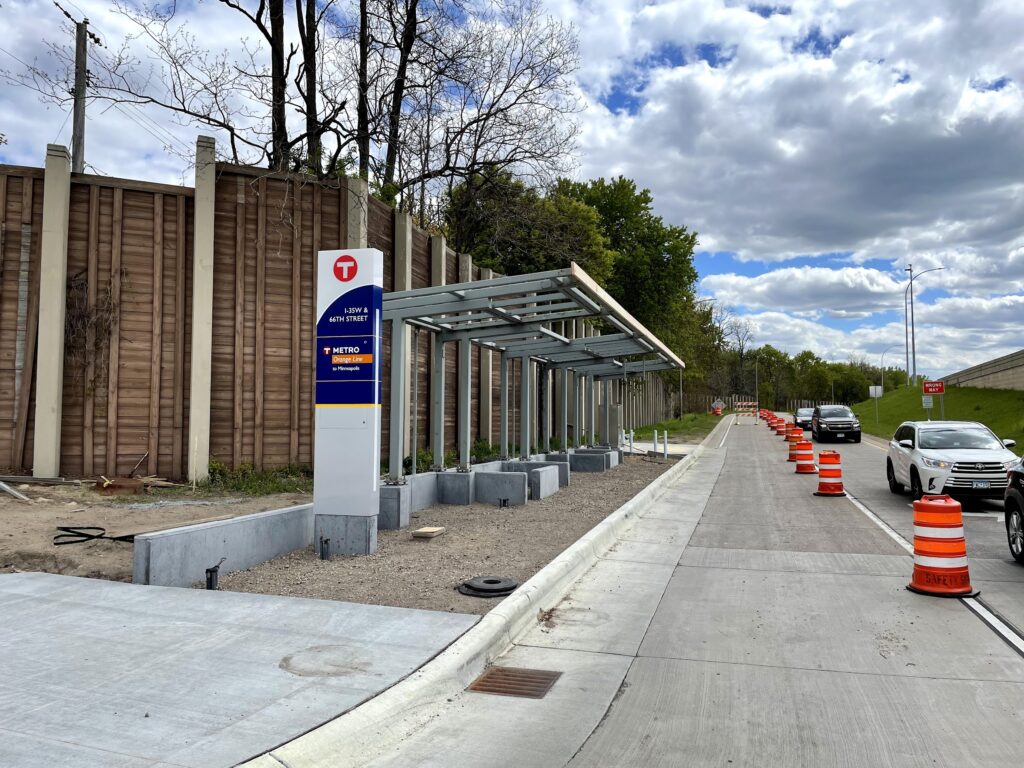
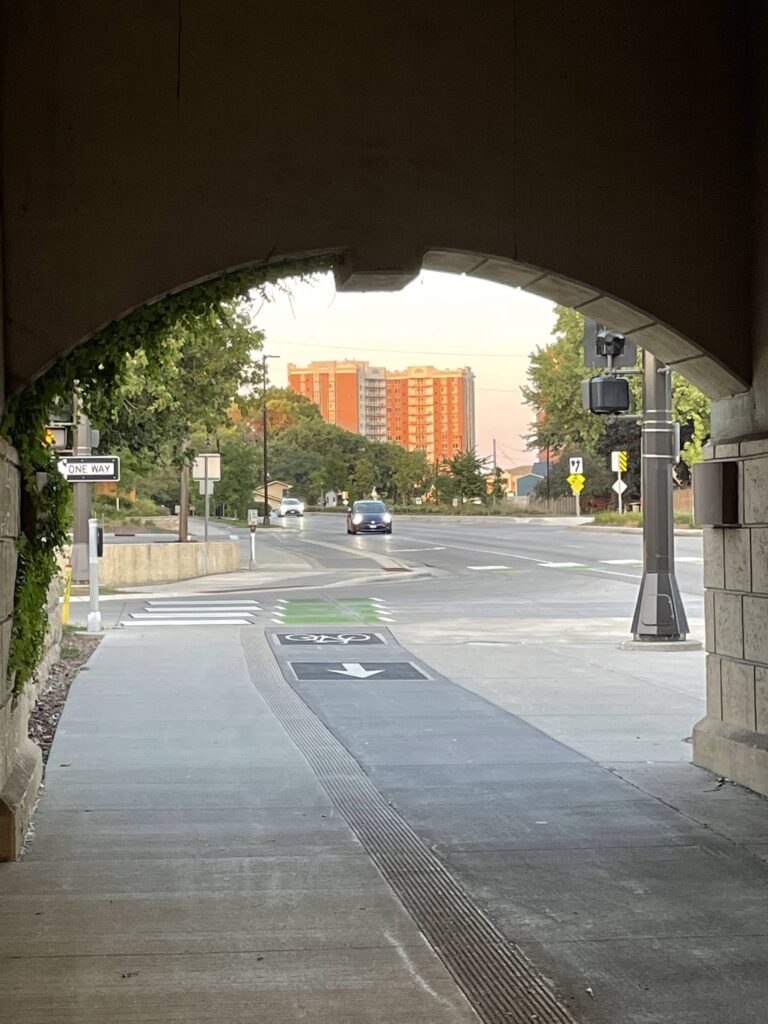
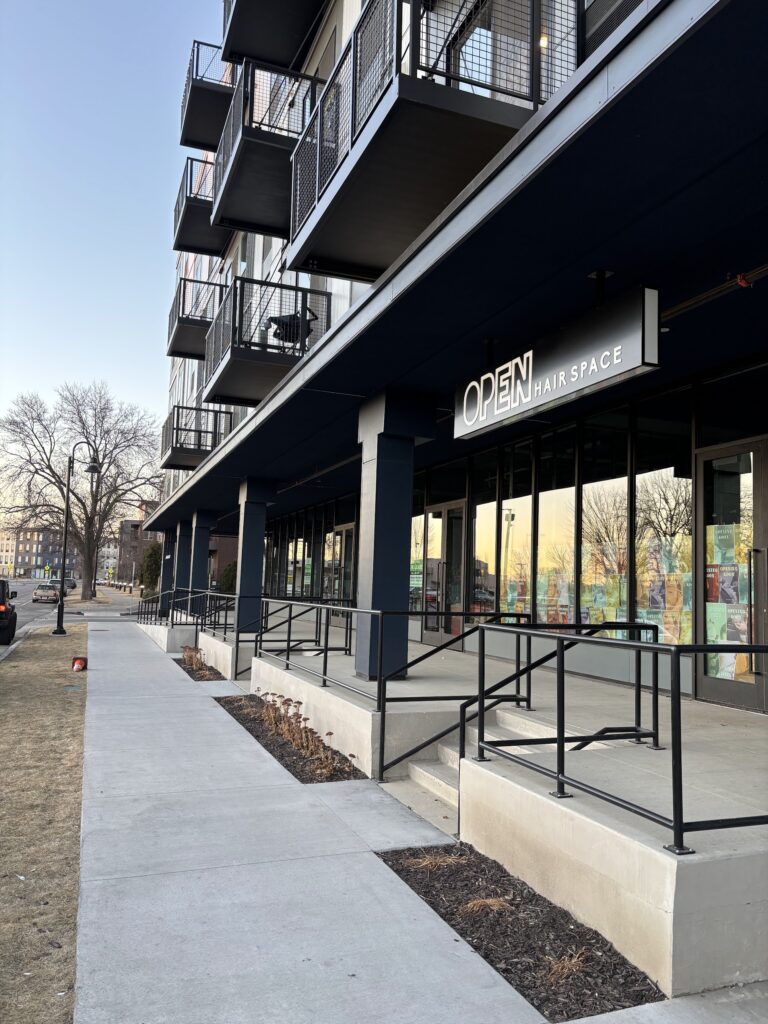
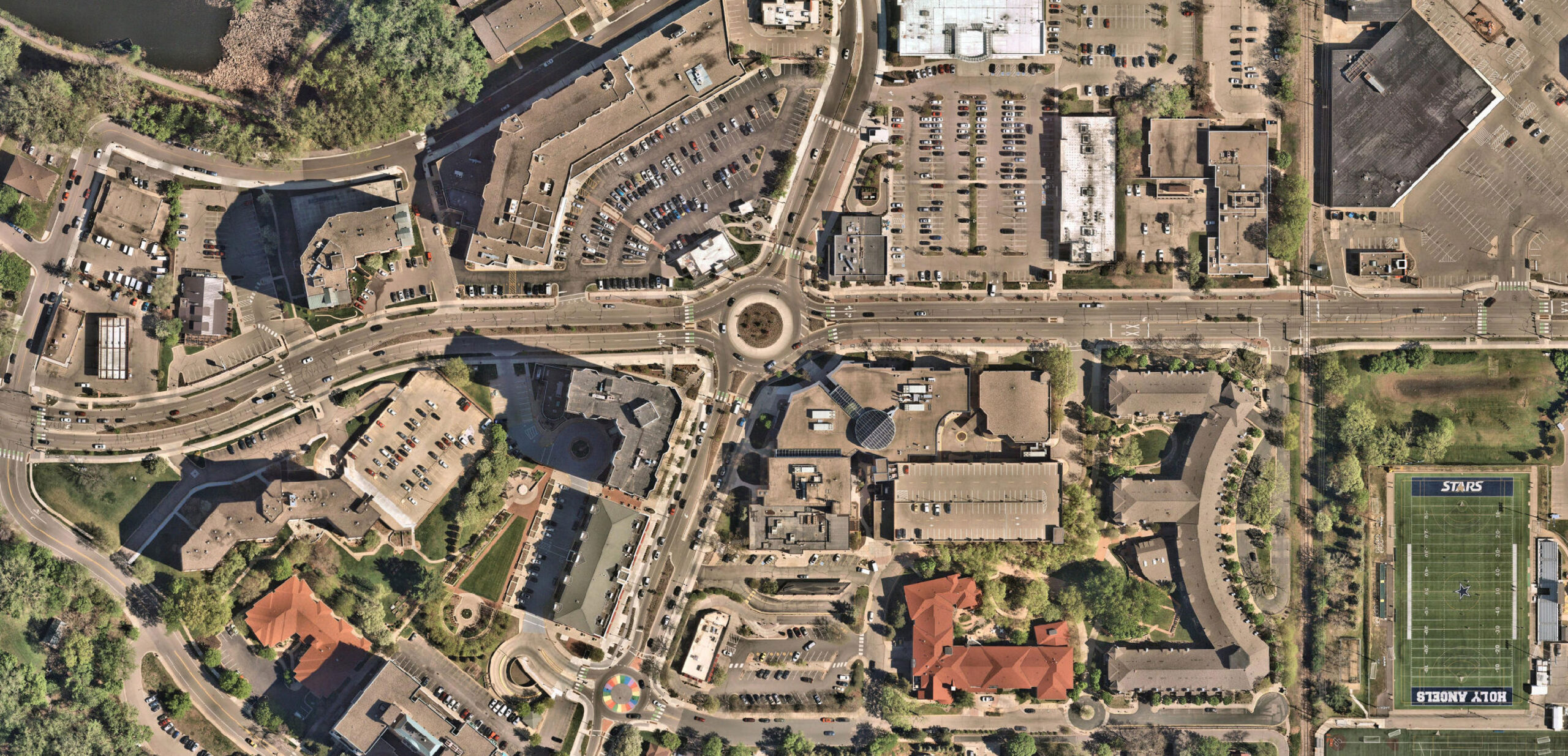
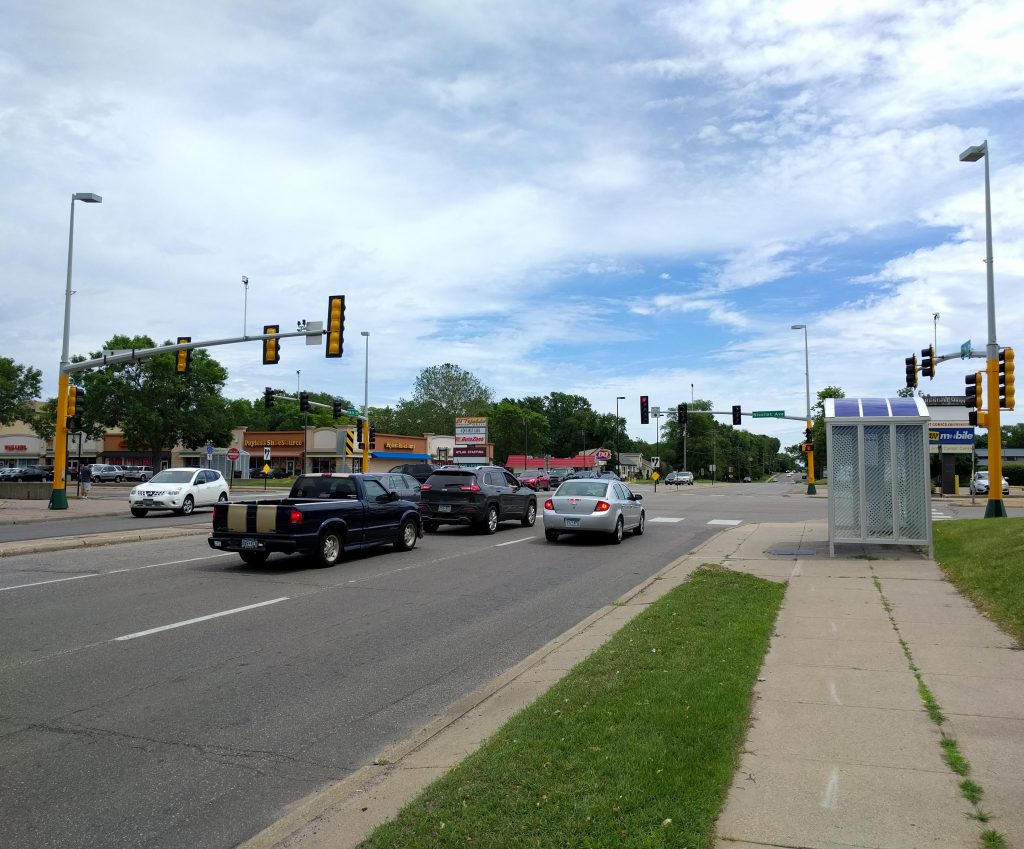
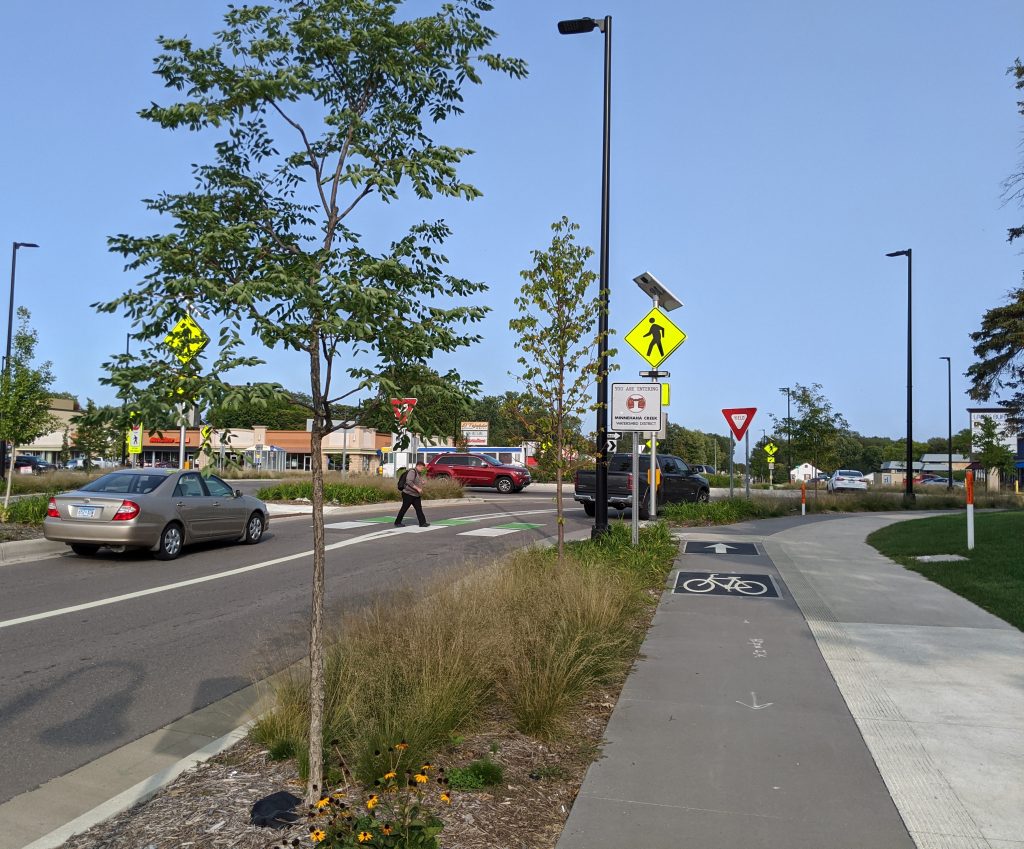
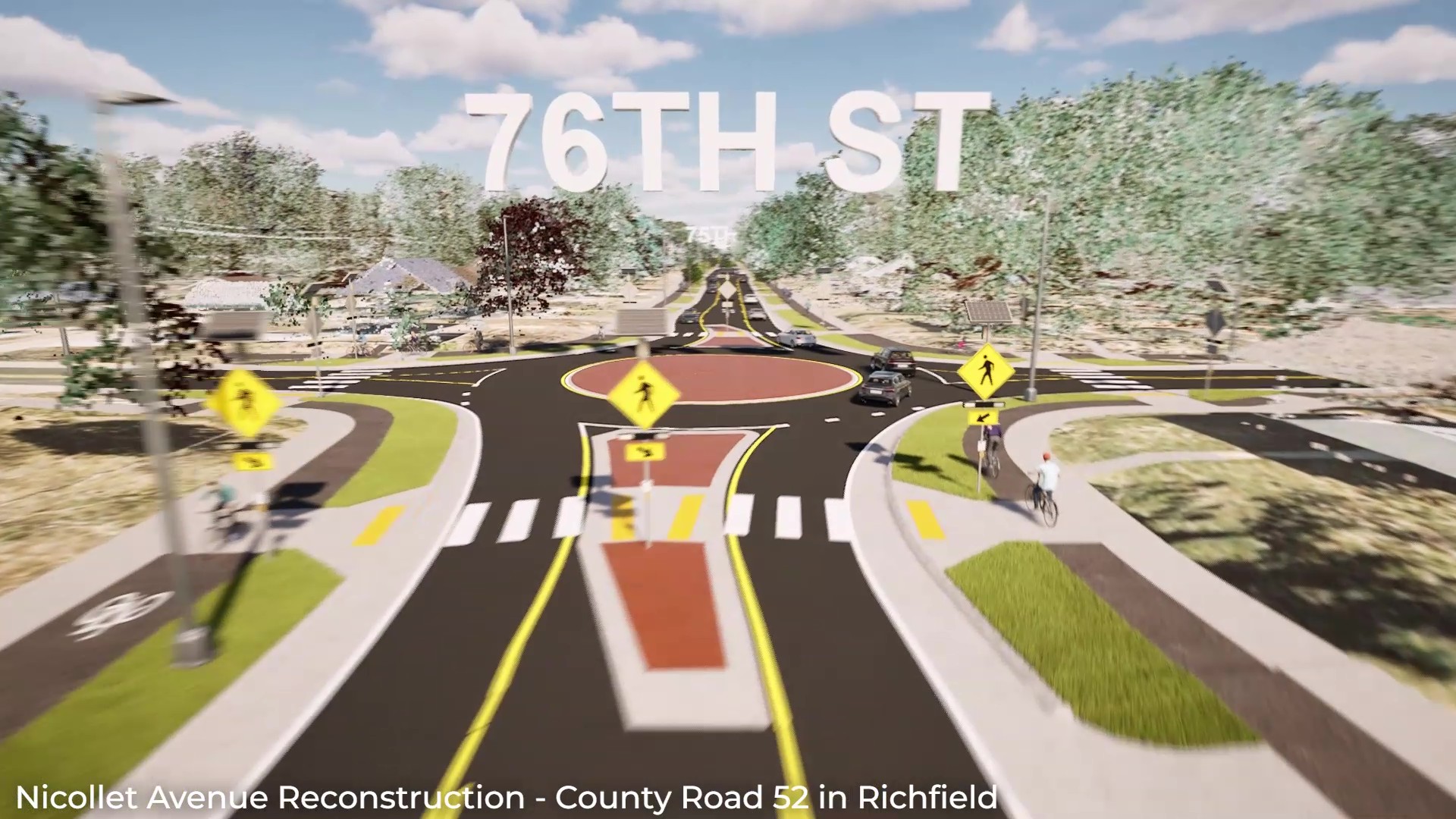
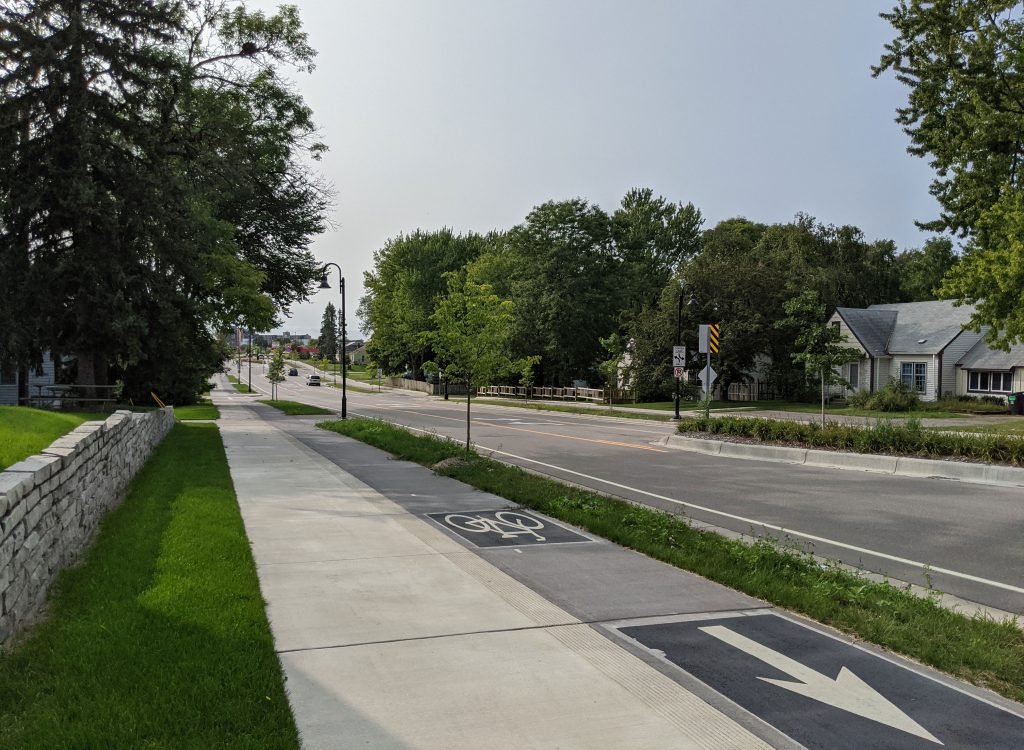
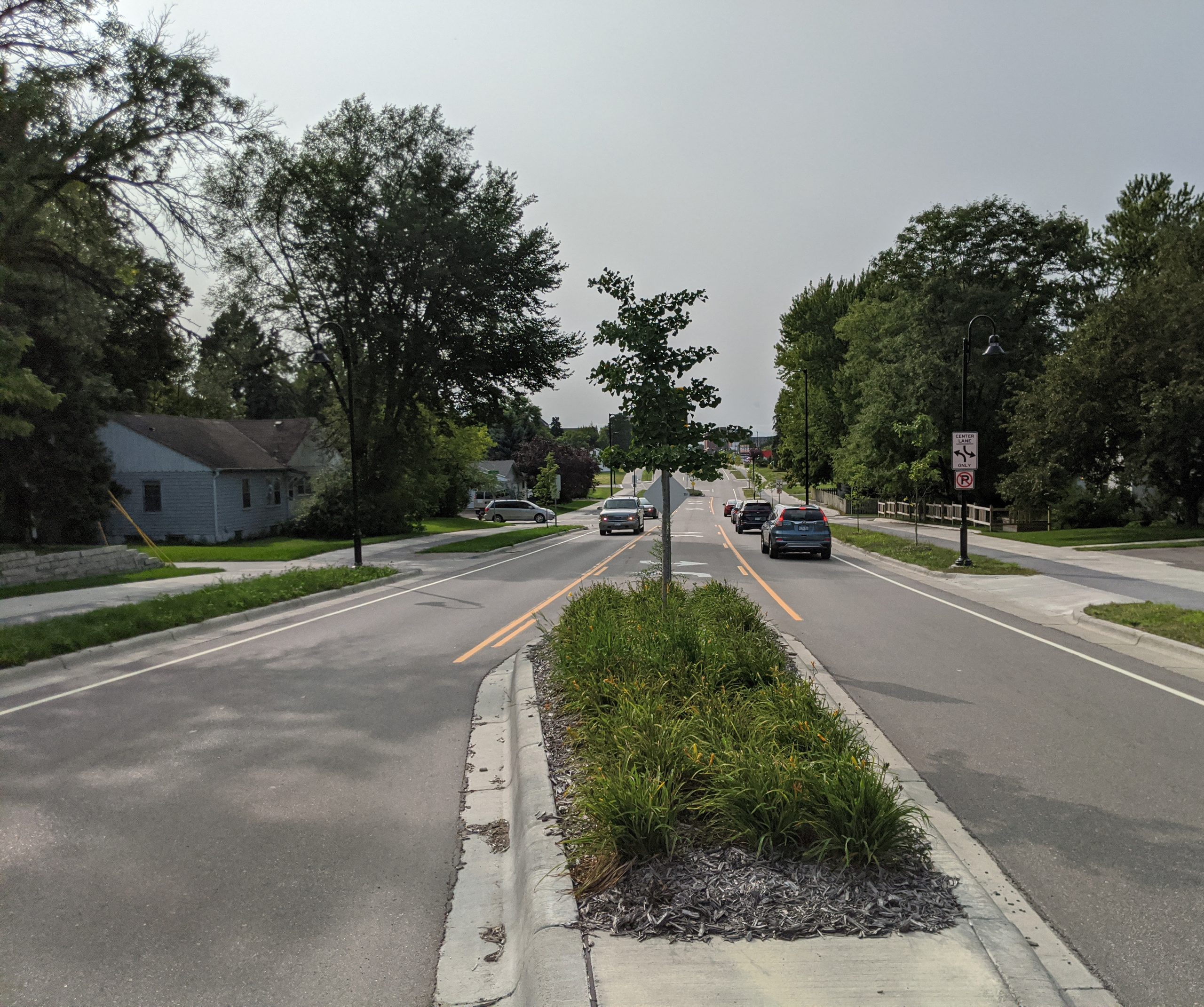
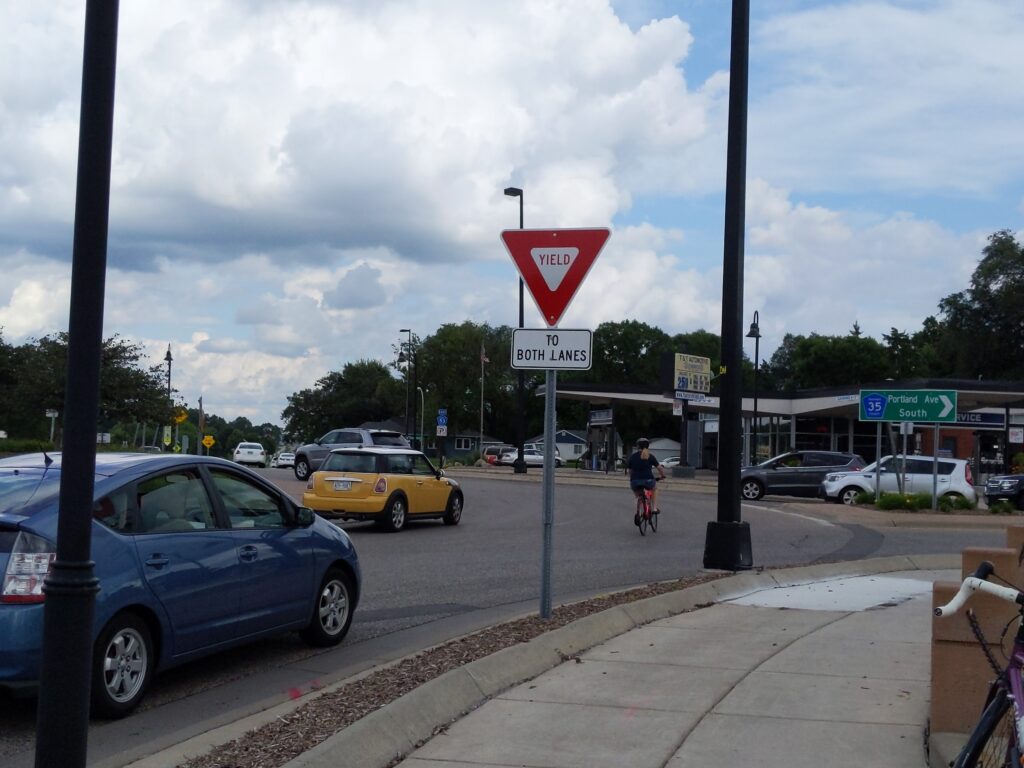
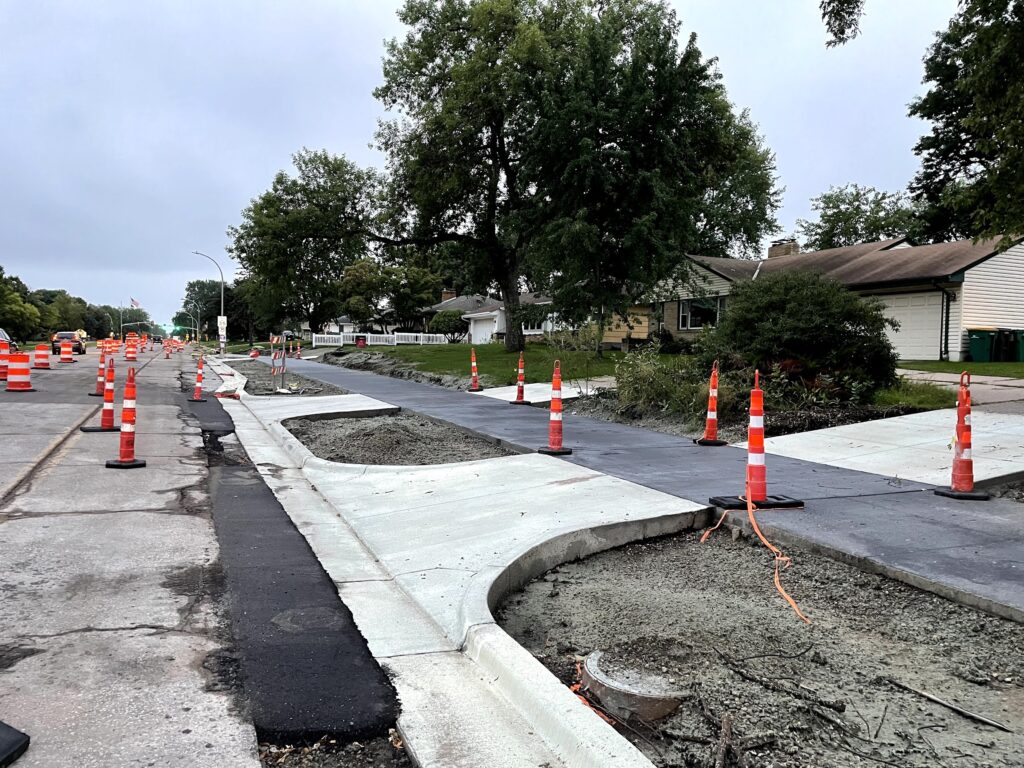
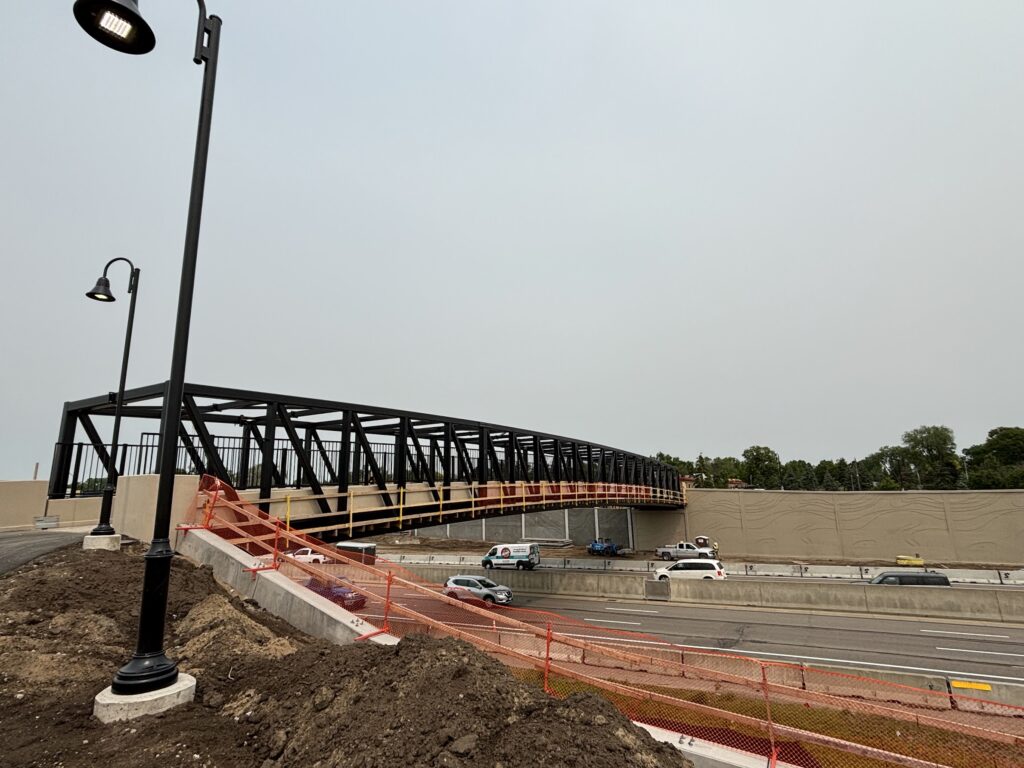
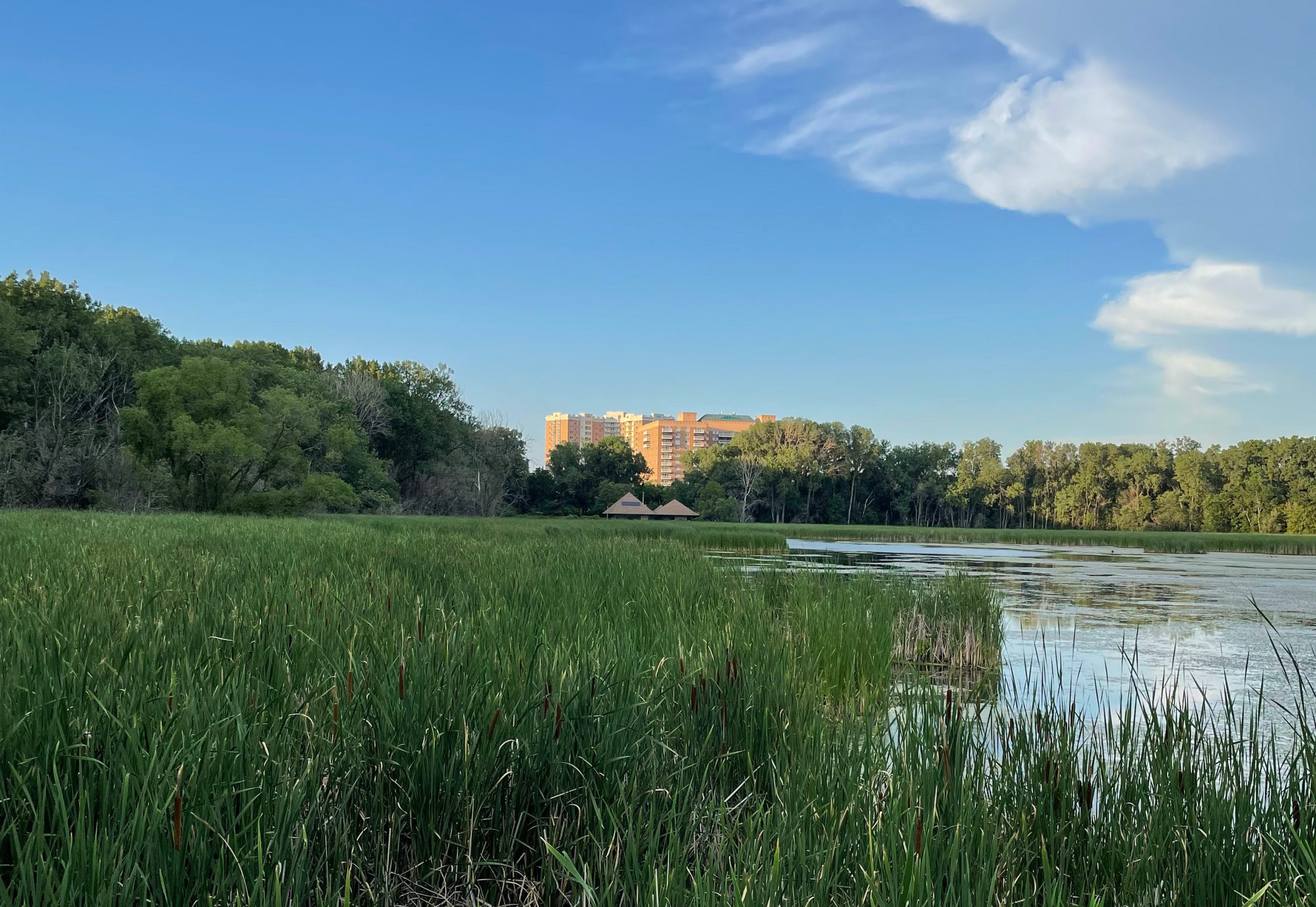
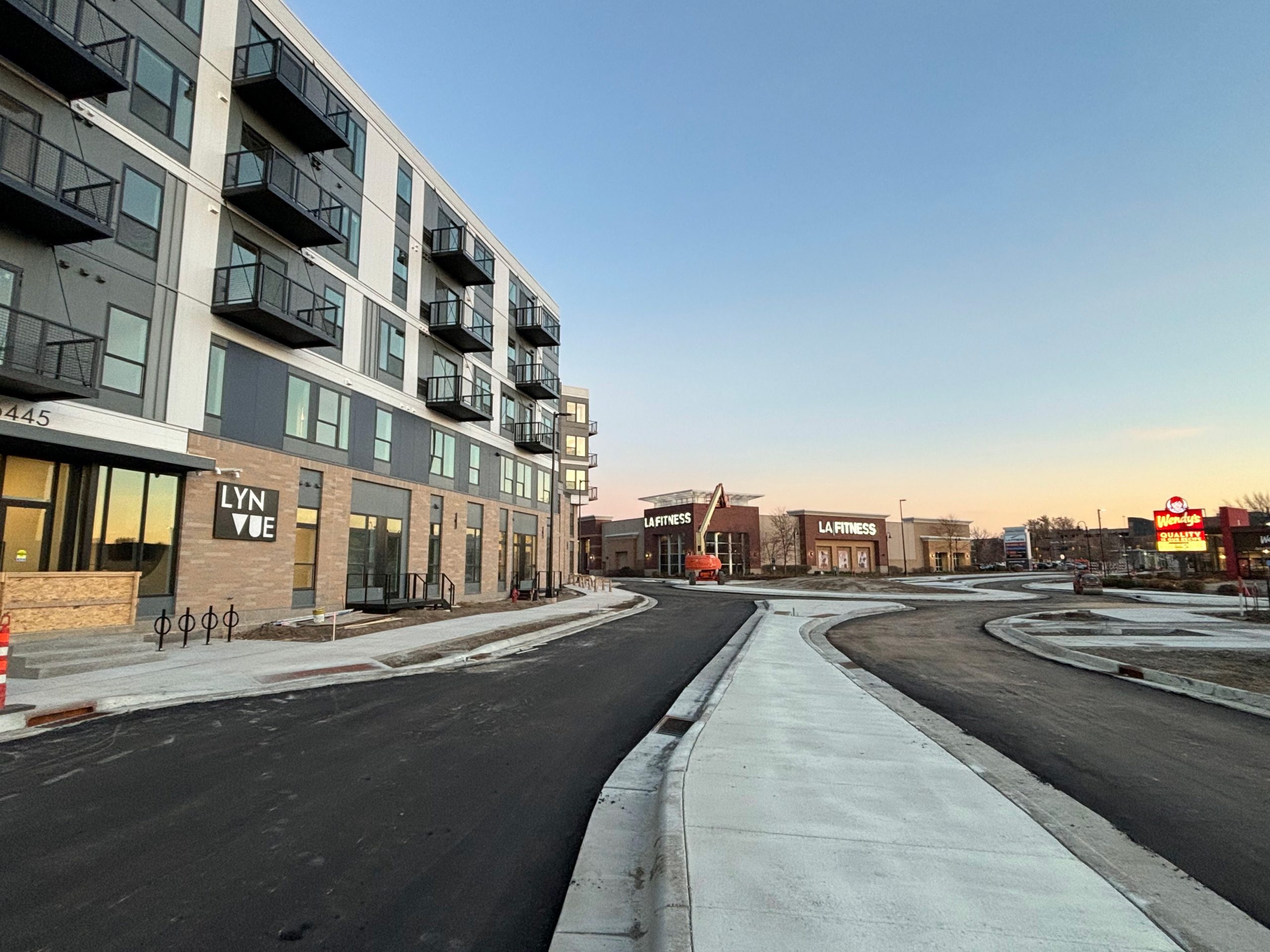
I-35W & 66th Street Orange Line Station, northbound platform during constructionProtected bikeway and sidewalk going under I-35W at 66th Street. Downtown Richfield in background.
Reflecting on the bus ride from downtown Minneapolis
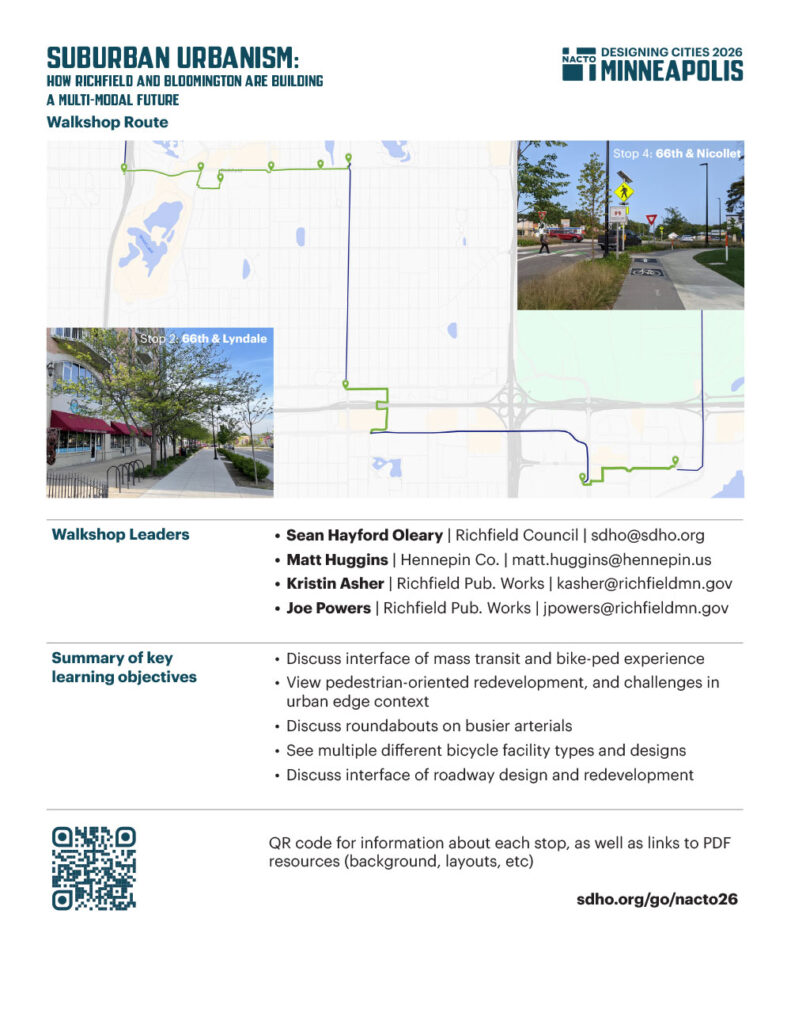
Discussing history of Orange Line bus rapid transit and relationship to other bus routes (D Line, K Line, and local bus routes including 515)
66th Street & 35W underpass design, retrofitted for road project
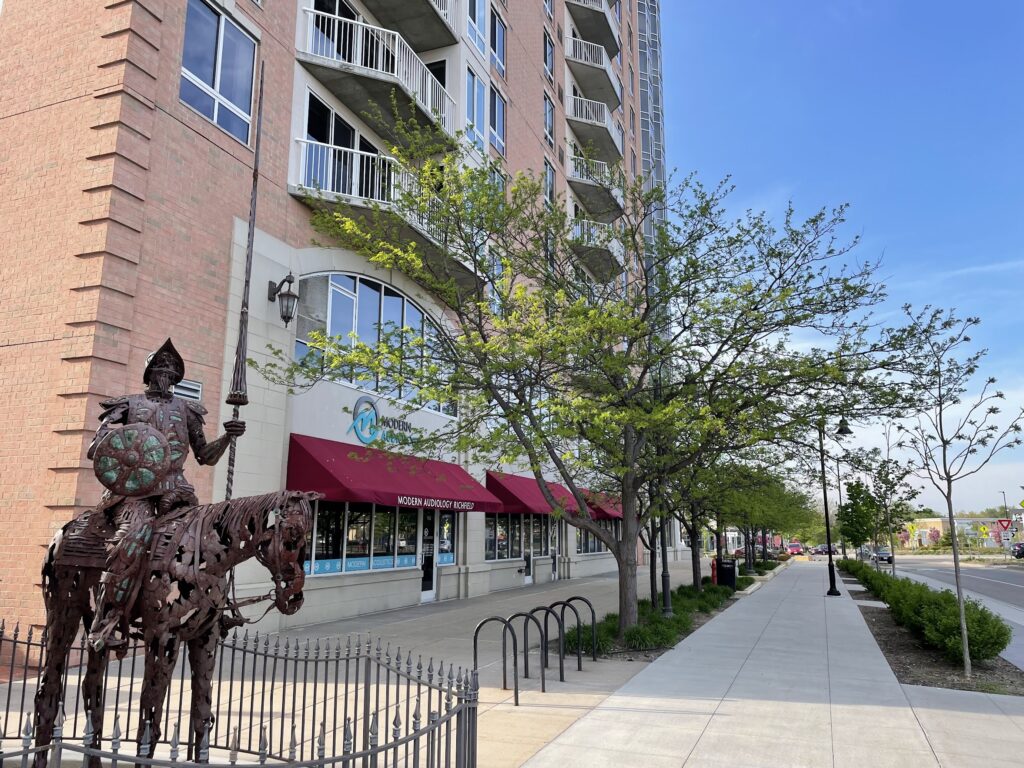
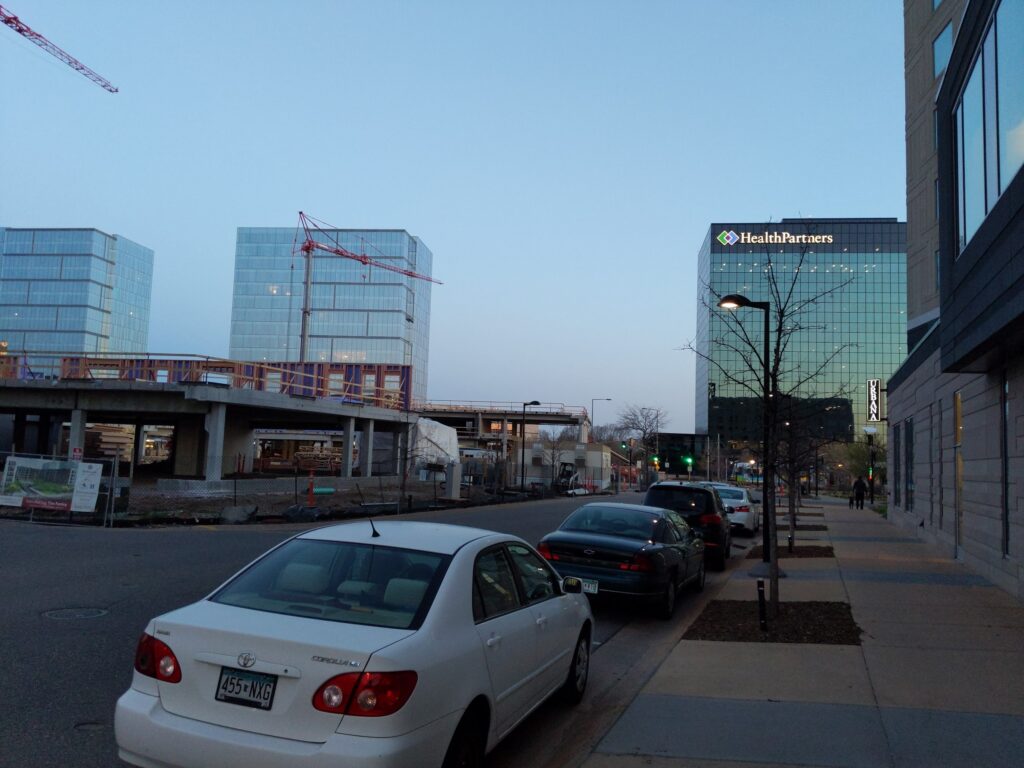
The 6600 block of Lyndale Avenue in downtown Richfield.Lynvue, a newer mixed-use rental project on the 6400 block of Lyndale
Richfield’s unique history of roundabouts — some of the busiest in the state. Check out the old Richfield Roundabouts website from when our first two opened!
Redevelopment, and challenges of creating great frontage in small urban-suburban downtown
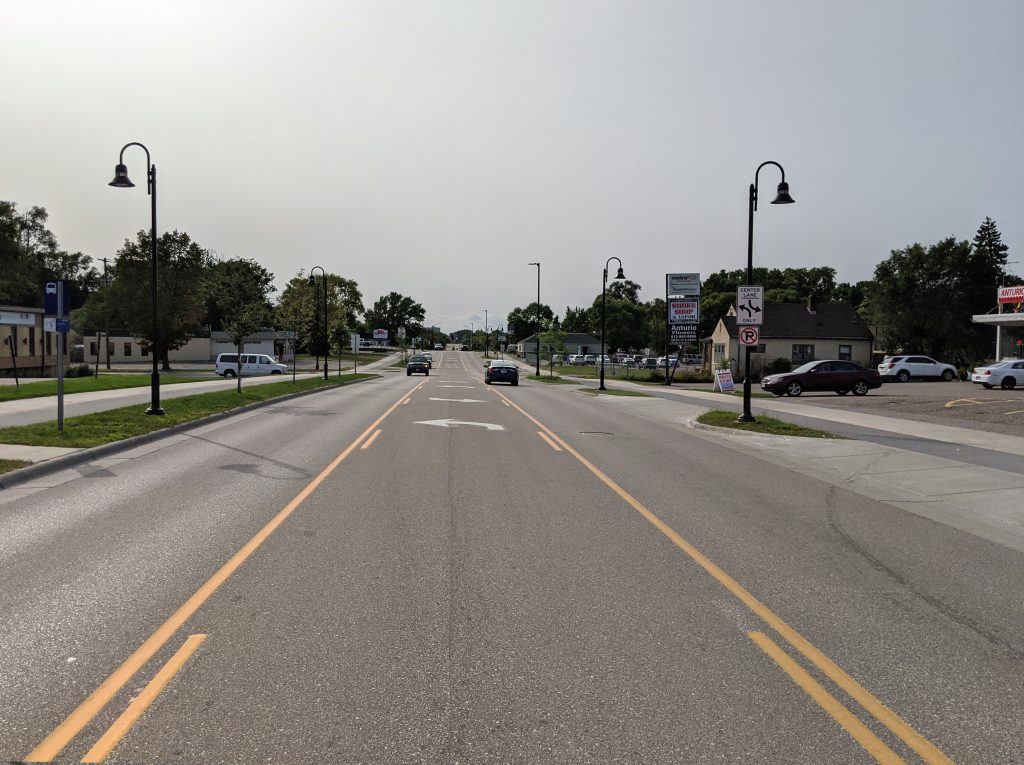
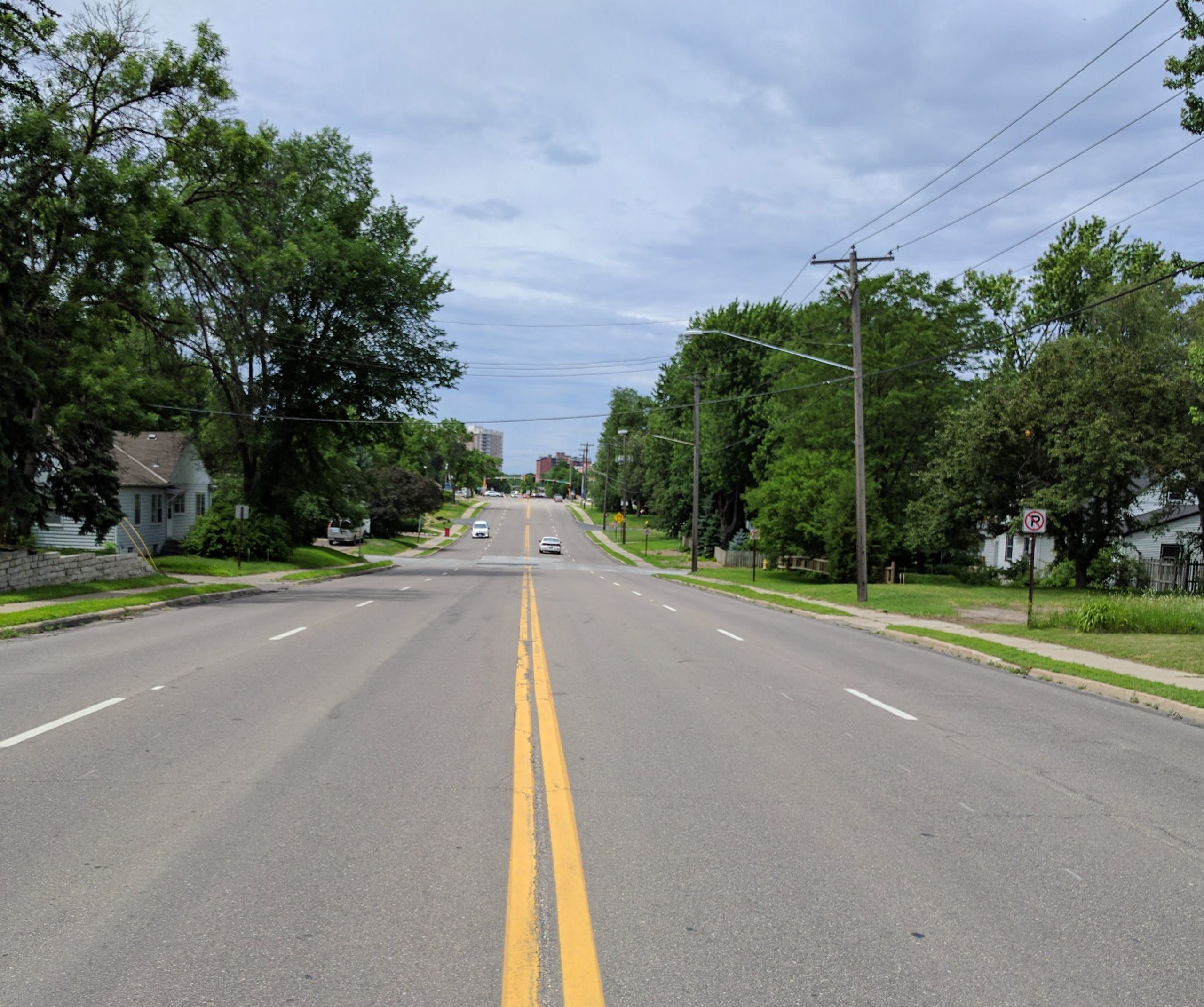
Lyndale Avenue reconstruction to the south, and modifications to the north.
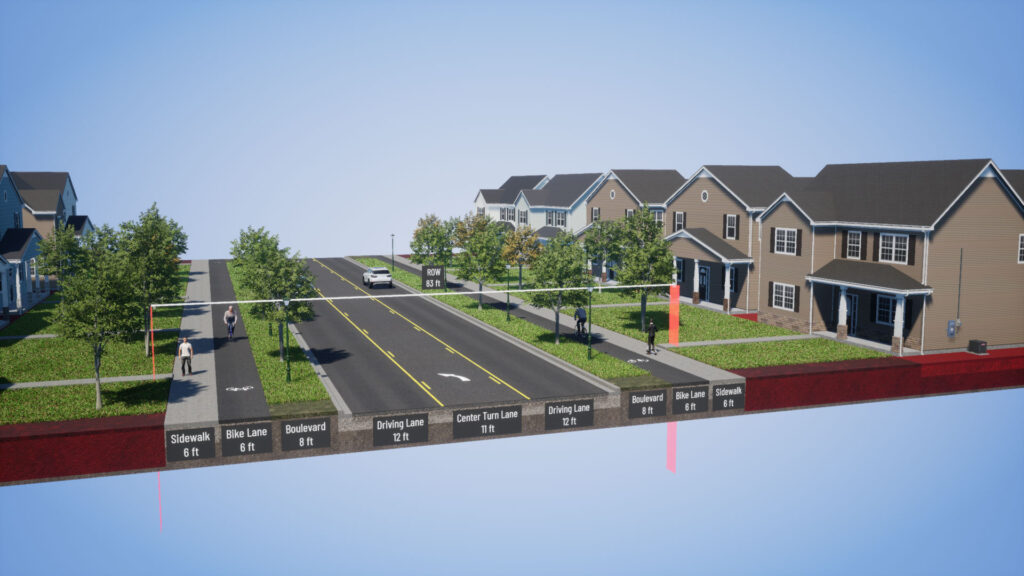
Protected bikeways and relationship between street design, maintenance, and building design (landscaping, bikeways, parking)
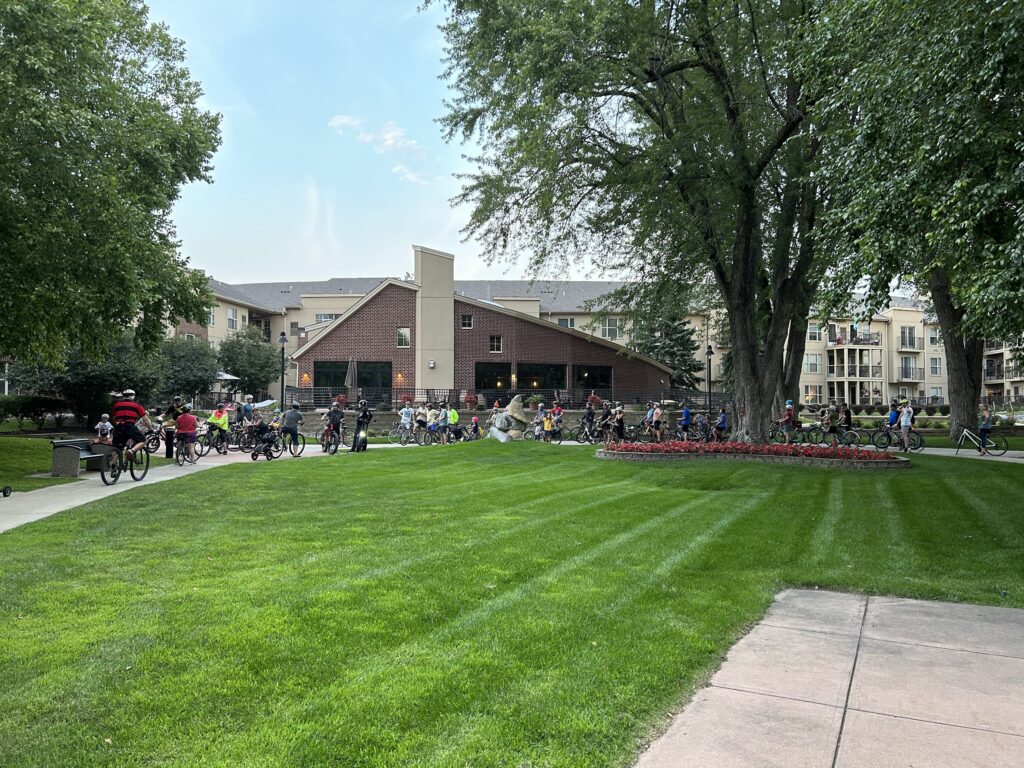
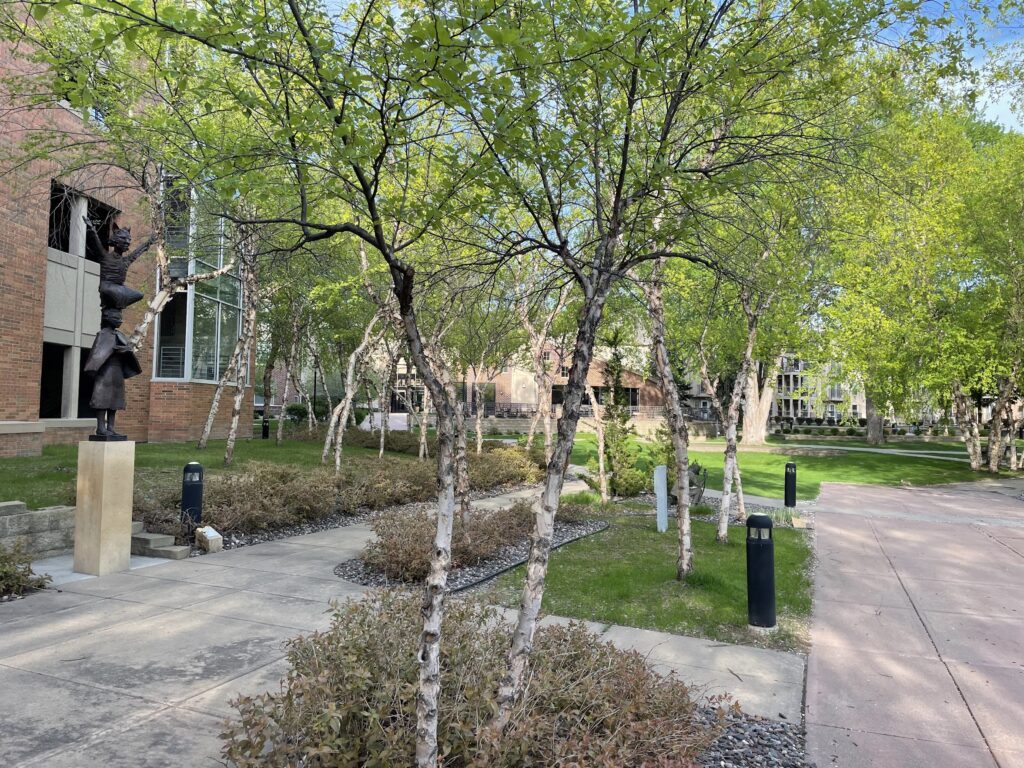
The lawn of the public-private Kirchbak Sculpture Garden in downtown Richfield, during a previous tour.The sculpture area of the public-private Kirchbak Sculpture Garden in downtown Richfield.
One of several “public-private” park spaces in downtown Richfield
Established as part of the massive “Richfield Urban Village” project
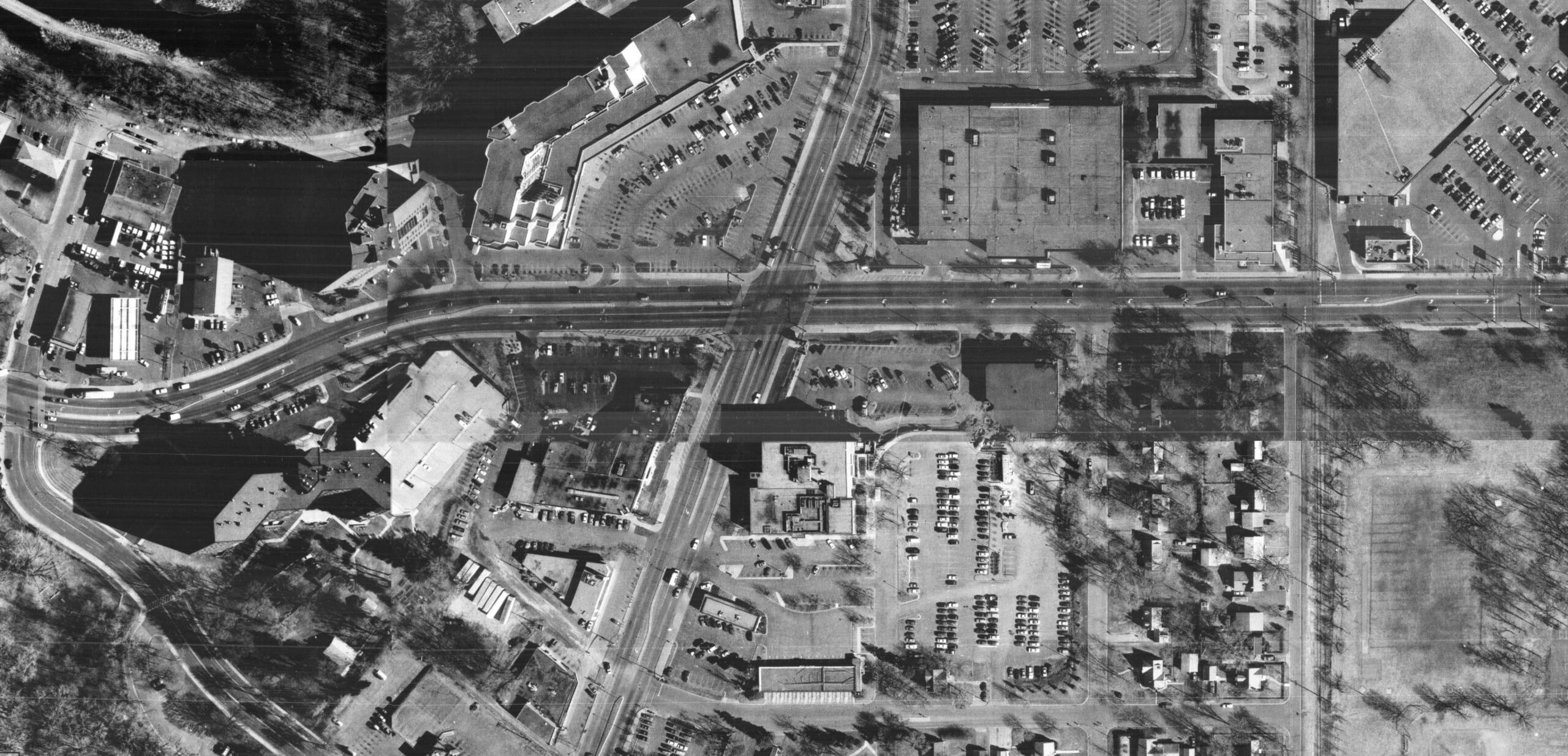
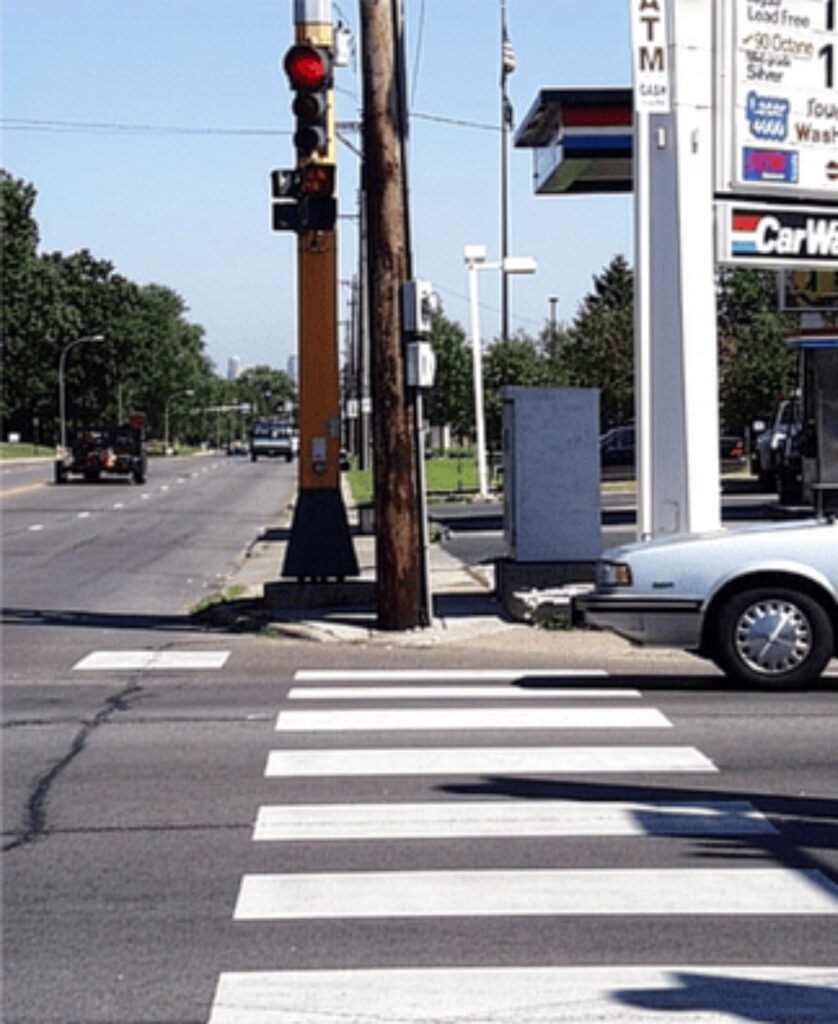
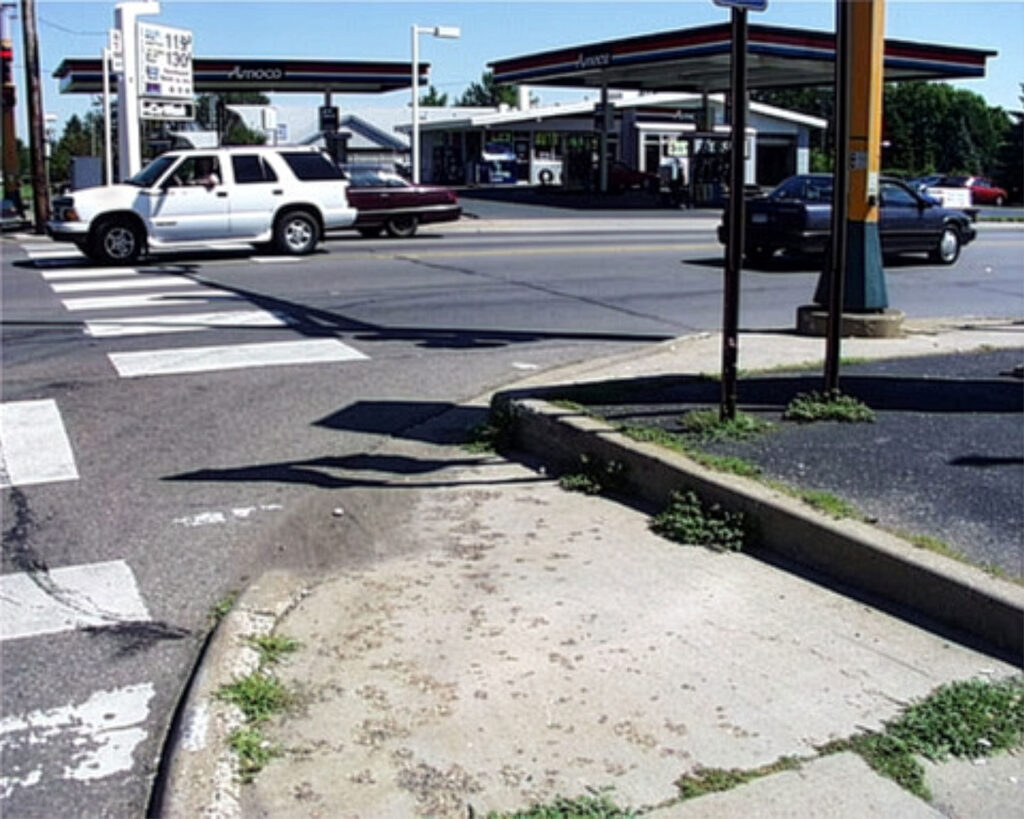
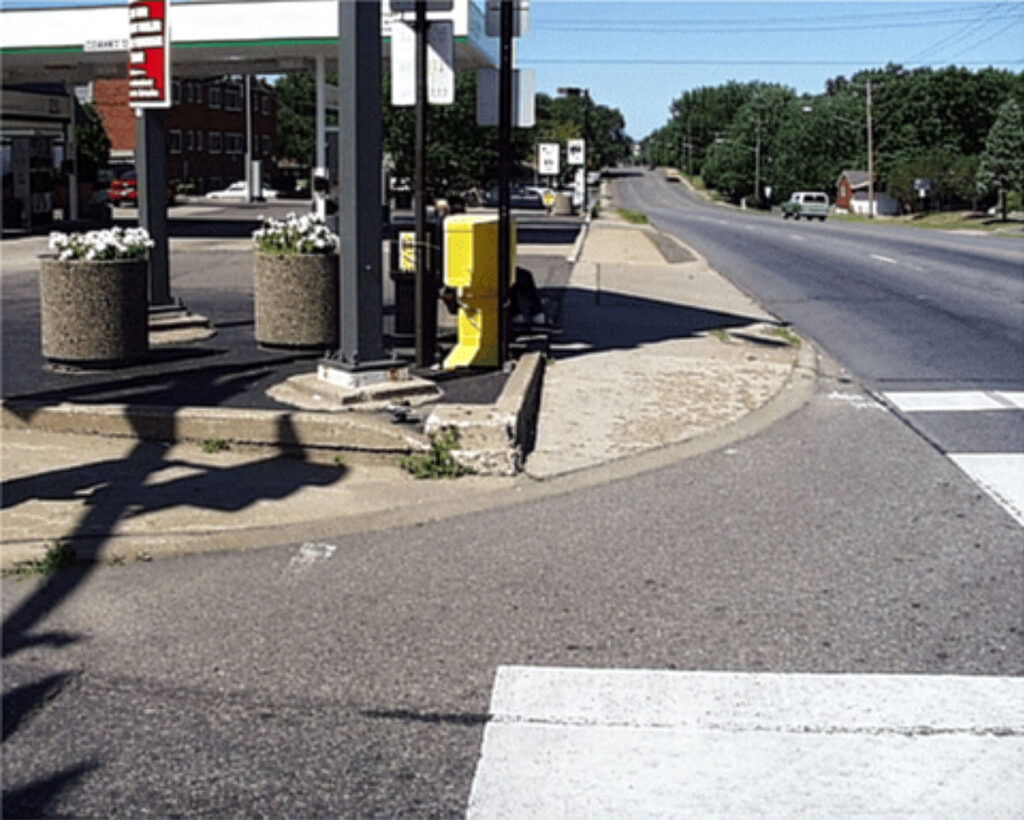
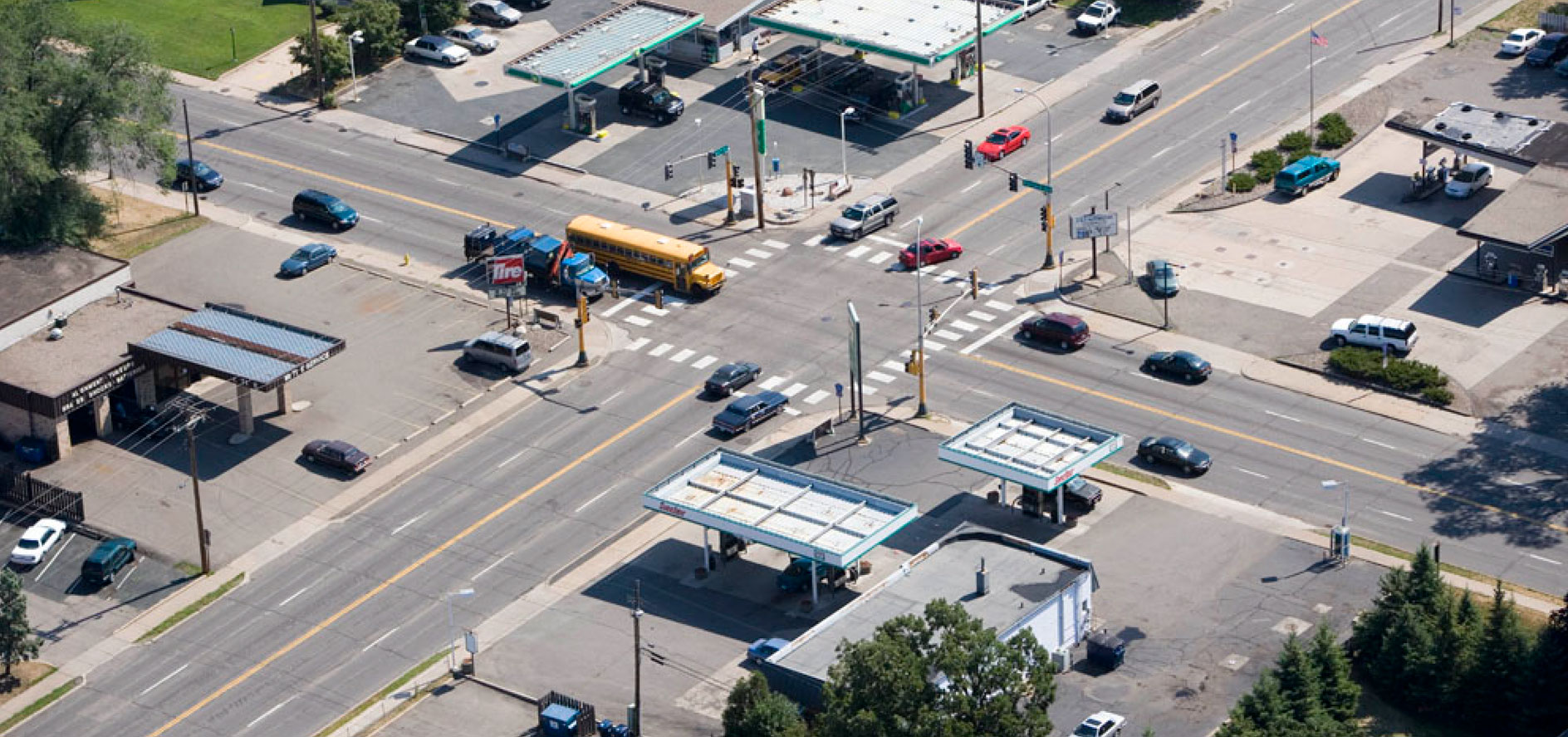
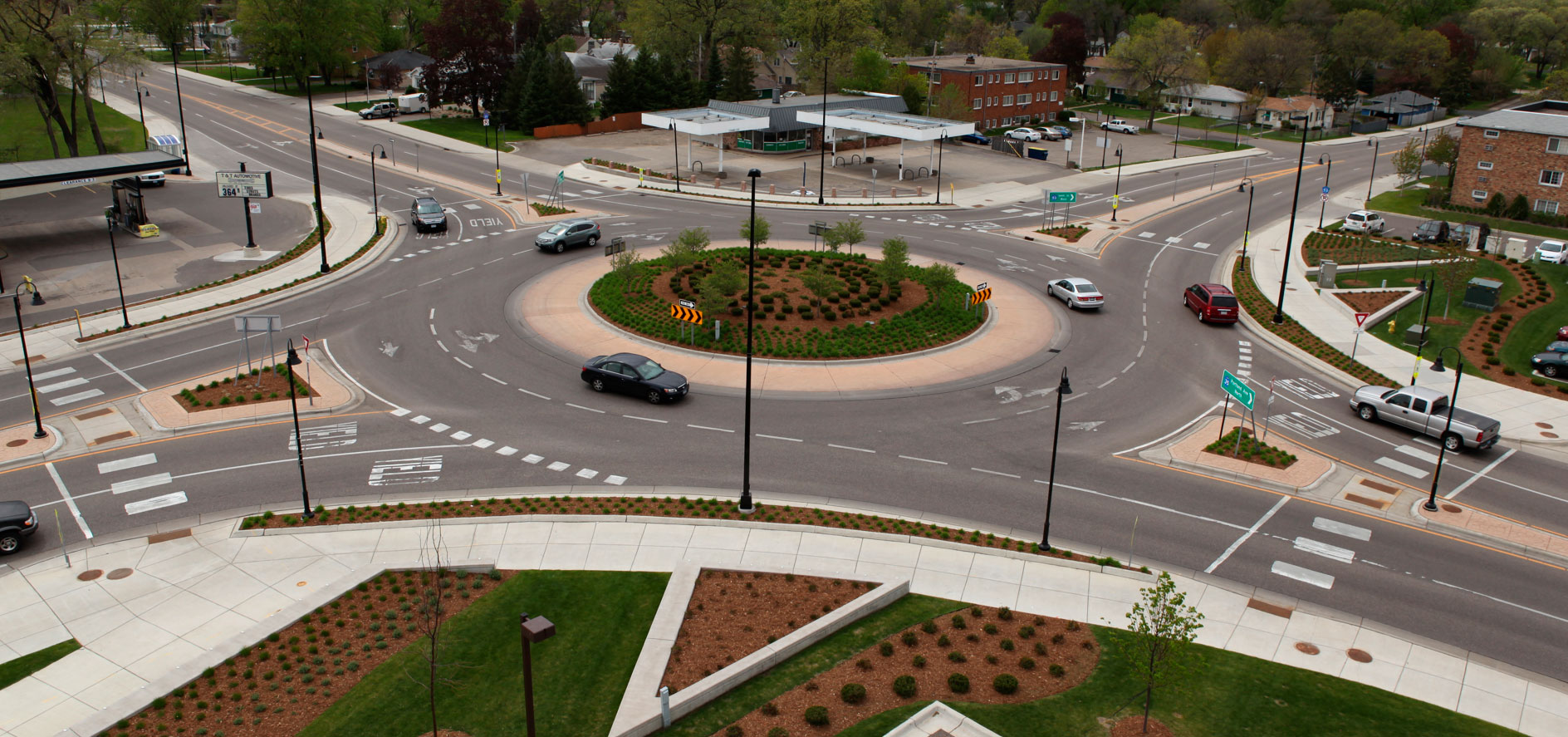
Portland & 66th pre-roundaboutNortheast corner of Portland and 66th before 2007, facing northView of the northeast corner of Portland and 66th before 2007, taken from southeast cornerView of the southwest corner of Portland and 66th before 2007, taken from the south leg crosswalk
Portland and 66th before and after rebuild — before is pre-2007, facing toward the northeast corner, after is post-2008, facing the southwest corner
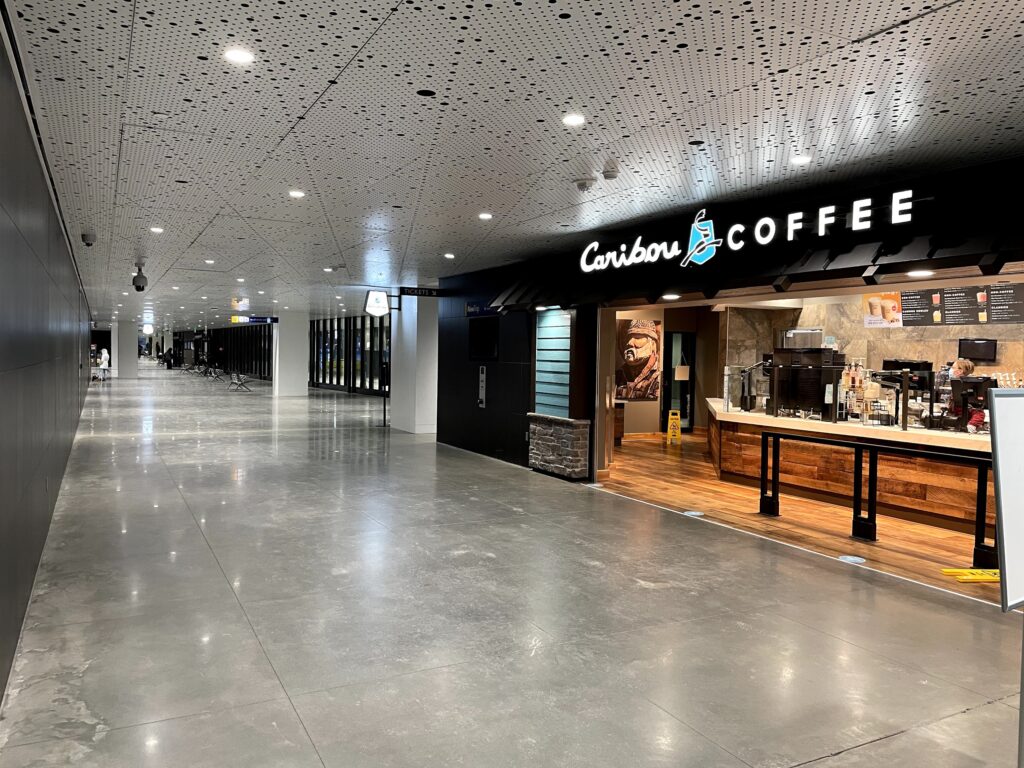
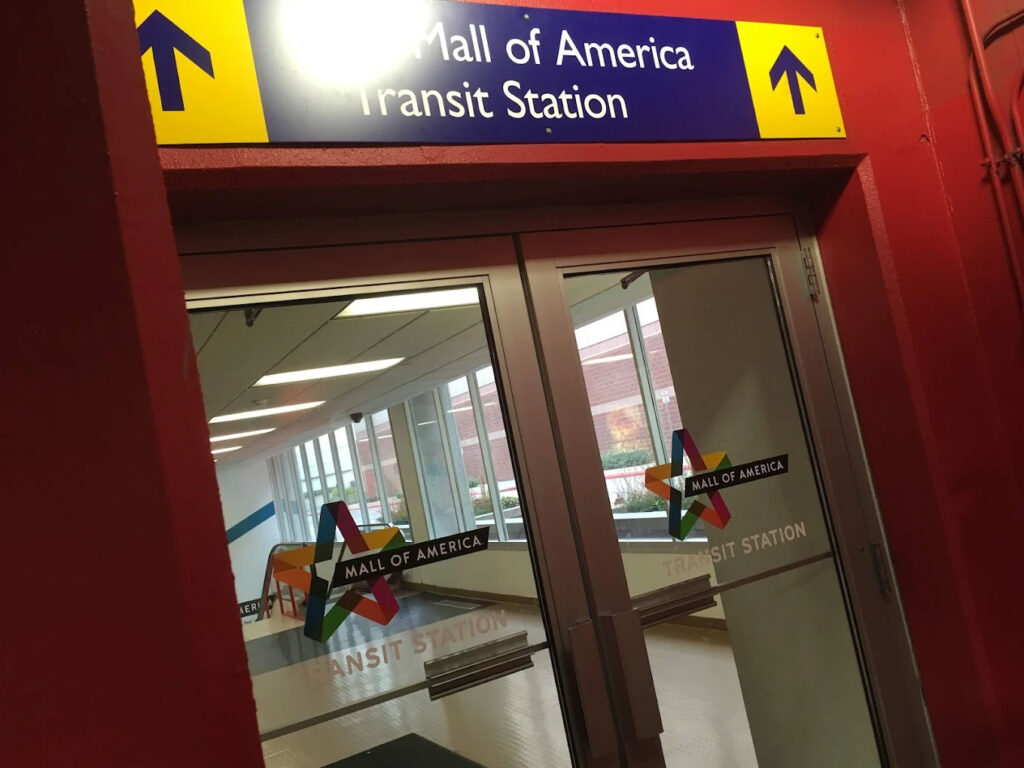
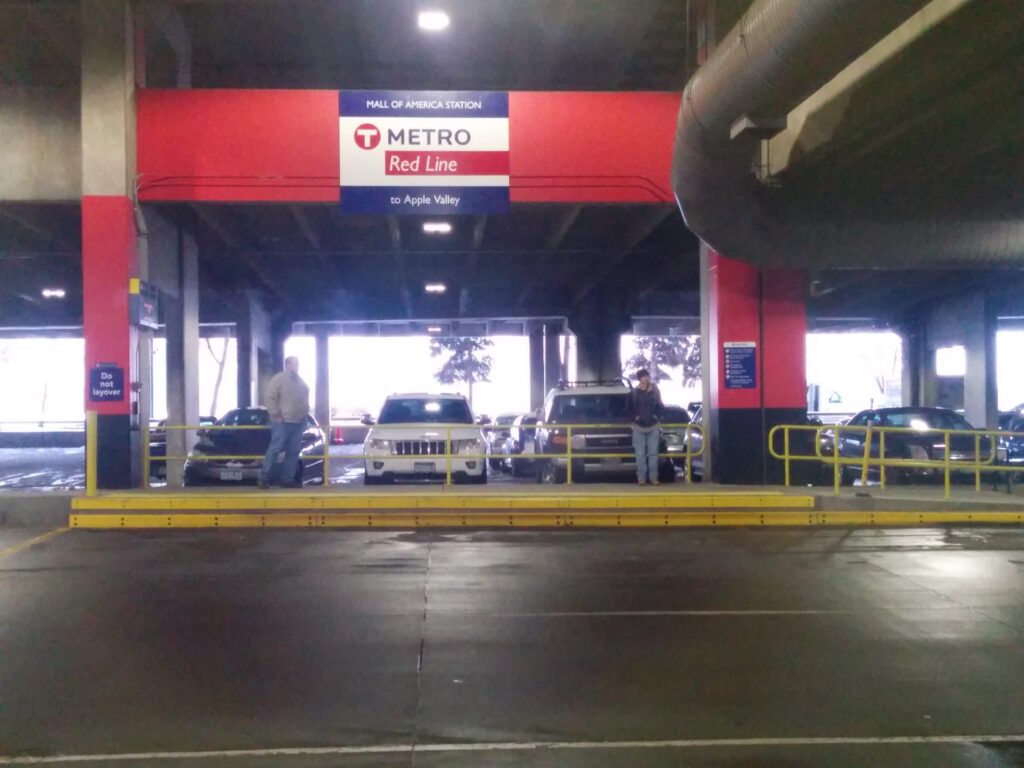
Connecting D Line, Blue Line, Red Line, and many local bus lines
Busiest transit station in the state
Significantly renovated 2020
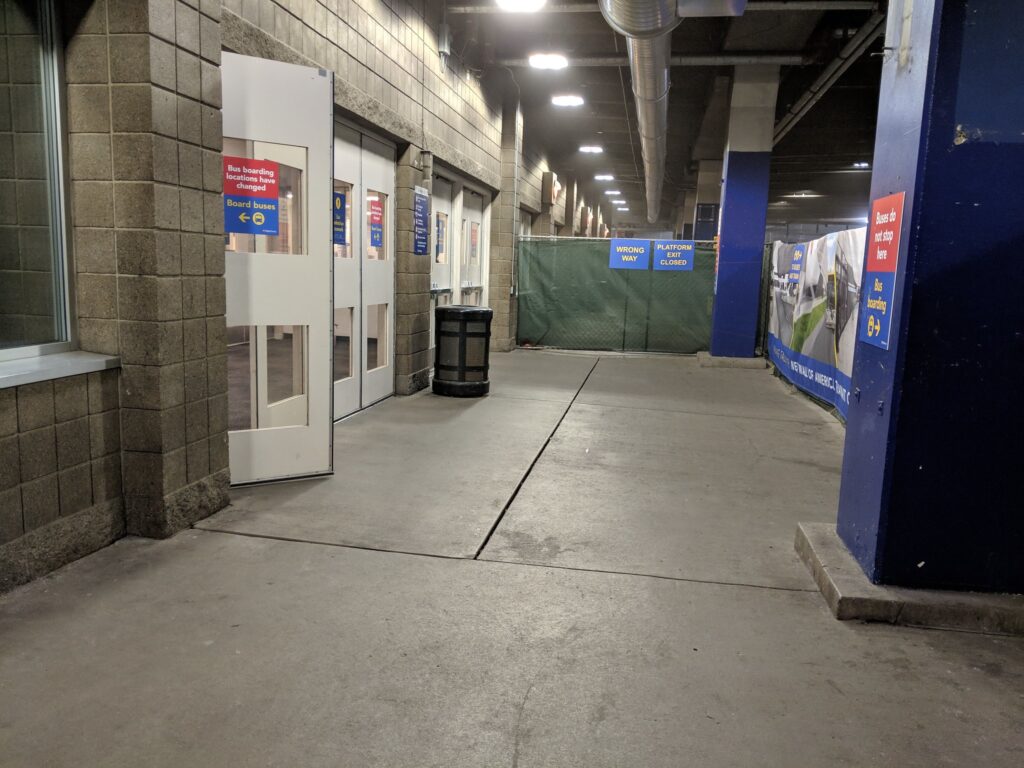
Mall of America Station prior to 2020 renovationThe primary entrance to station used to be from parking ramp only, not mall interior (photo by LocalMN Interactive)Boarding area prior to 2020 (photo by Mike Hicks)The original Red Line boarding area at Mall of America Station prior to 2020
Thanks to Kate Aitchison, Mary Supple, Katie Rodriguez, Melissa Poehlman, Julie Urban, Kristin Asher, and Karl Huemiller for their review and feedback!
A good street is a place where people can navigate among businesses, services and social spaces safely and comfortably. In addition to being pleasant and socially productive, these places are financially productive for towns, producing more tax revenue per acre than other development patterns. Unfortunately, many streets sacrifice safety in an effort to prioritize automobile travel at high speeds; this kind of bad street design is the primary cause of vehicle crashes involving fatalities and traumatic injuries. What are people in your city doing to build streets that prioritize people and merely accommodate automobiles — not the other way around?
A:
Richfield is a leader in street design that builds community and improves safety for people walking and biking. Richfield’s first generation of arterial streets were four-lane, undivided “stroads” with 35 mph speed limits, no bike space, and barely-usable sidewalks. Our resident-led Transportation Commission and professional engineering staff worked together to change this approach. We saw the first tangible results in 2010: rebuilding one of our city-owned streets from 4 lanes to a 2-lane roadway with bike lanes, grassy boulevards, and improved sidewalks.
Since then, our progress has accelerated — fully reconstructing 7.1 miles of arterial streets, and restriping, lowering speed limits, and doing other retrofits to an additional 7.7 miles of arterials. This has resulted in a high-quality network of bikeways and ever-improving pedestrian space. In 2016, Richfield installed the longest protected bike lane in the region, with 2.75 miles of 66th Street featuring one-way protected bike lanes. The new 66th provides safe access to 16 parks within a quarter-mile, including the city’s swimming pool. We plan to utilize a similar design in our city-county reconstruction of Nicollet Avenue in 2026.
Richfield has also been a leader in roundabouts, with eight roundabouts added on arterial streets since 2008, and an additional five planned by the end of this decade. This has reduced the need for multi-lane intersections, and improved safety for all users. We have also continually improved these designs to enhance pedestrian comfort based on user feedback.
We have done all of these arterial improvements without the use of special assessments — our arterial streets are shared amenities that benefit the whole community, and it has been our practice to avoid special assessments for these streets.
Q:
Excessive surface parking harms towns. It makes them less financially productive and prevents new local businesses from getting started. It forces land owners and developers to build more parking than they actually need, often at the expense of more housing. Still, most North American cities require this excessive parking in their codes in the form of parking minimum mandates. If you’ve had this experience in your place, you’re not alone, but we hope you’re taking steps to change that. What policies and approaches are people in your city using to decrease or eliminate parking minimum mandates and encourage development that is more productive than parking lots?
A:
Richfield continues to make progress on reducing surface parking requirements. Although we have not completely eliminated parking requirements, we have worked to ensure that they are at or below market norms. In addition, we impose parking maximums to dissuade excessive parking.
We continually review and reduce requirements in response to market changes. Within the last two years, we reduced our parking requirements for houses, for apartments, for restaurants, and for museums and libraries. In fact, the last change has allowed our local library to reduce its parking lot nearly in half, allowing for more green space in a major park — and less unsightly, unnecessary pavement. City leaders will be considering additional reductions to parking requirements — including the possibility of elimination — downtown and along major transit lines through policy work planned for 2025.
Our parking requirements do not only serve cars; in recent years we have expanded requirements for electric vehicle charging, and adopted a comprehensive bicycle parking strategy — including support for e-bikes, sheltered parking in new housing, and creating a standard that prioritizes parking at bikeable/walkable businesses.
Our mixed-use zoning districts discourage the use of excessive surface parking, and nearly every major redevelopment has included structured parking.
Q:
Your city’s housing market should be flexible enough to respond to evolving needs and capacity, yet most communities have rigid zoning laws that prevent even the simplest of changes. What are people in your town doing to promote the incremental and bottom-up development of more housing options and greater housing flexibility?
A:
Like many American cities, Richfield’s largest era of growth was post-World War II, where we expanded from a village with scattered housing developments to a fully developed, gridded, and dense city.
As late as the 1990s, Richfield’s zoning changes prioritized competition with newer suburbs, emphasizing suburban design features like large lots, multi-car garages, and allowing only single-family homes in the vast majority of the city. This was not a financially sustainable approach, since it meant fewer homes could be built in the same area, and at a higher cost for each one.
In the last 15 years, Richfield has diversified its approach, adding over 1000 new housing units, and updating our comprehensive plan and zoning code to allow a greater diversity of housing choices. This included “legalizing Richfield” — expanding areas where apartments can be built, re-allowing duplexes by-right, and allowing smaller lots that were already common in parts of the city. We also allow accessory dwelling units (ADUs), and were one of the first cities in the Twin Cities metro to do so.
Nearly all major redevelopment areas of the city use a flexible, mixed-use zoning that prioritizes attractive and human-centered design over specific edicts on use. In our downtown, we allow densities of up to 200 units per acre, and allow relatively high densities in all of our mixed-use districts.
The changes in Richfield’s approach on housing development aren’t only on the ground, but in philosophy: the most recent changes have prioritized having clear, universal rules for development by right. This contrasts with many peer cities that have highly restrictive zoning codes, and allow for most development only through extensive use of planned-unit developments (PUDs), or many variances. Simpler rules promote fairness and predictability, and allow smaller developers to develop in our city more easily.
Please answer all of the following 3 questions.
NOTE: These ended up being non-paragraph, single-line text fields. As a result I had to significantly shorten the answers.
Q:
In a truly strong town, elected officials and residents work together to prioritize their community’s needs. What does communication between elected officials and residents look like in your town? *
A as submitted:
Richfield uses resident boards to study policy changes in detail and engage with the City Council and the community at large. Many of these boards are unique to Richfield, like our Transportation Commission, that helps co-create new street designs with engineering staff and residents who use the street. We’ve worked to make more information about our meetings available online and ensured apartment residents receive the same information from the city as homeowners. And city staff and council members are present at many community events, both ones led by the city as well as privately organized festivals.
A (original full answer):
Richfield has worked to be increasingly transparent and engaged with the community. For decades, we have had resident boards that study specific areas in detail and advise the council in decisions. Some of these boards — such as the Planning Commission — are dictated by state law, but most were created at the discretion of the City. These allow resident input in a deep and meaningful way that most cities don’t have a structure for — like our Transportation Commission, that hosts community open houses and helps guide design for new streets alongside professional staff. Council members participate with these boards as well, allowing them to better represent these resident ideas, as well as to communicate Council work to these highly engaged residents.
In recent years, Richfield has made efforts to be more transparent and clear in council decision-making. A decade ago, nothing more than the time and date were posted online about council work sessions — now the full packet, slides, and even audio recordings are available for all to access. For public hearings for land-use applications, Richfield goes above and beyond state requirements by sending notices to each individual apartment resident, as opposed to only the building owner.
Richfield also engages residents informally — the City’s Richfield Recap newsletter has 4,000 subscribers who receive weekly updates, with a 75% engagement rate. Our social media pages update residents on Facebook and Instagram. And staff and elected officials actively participate in many community events, including our annual PennFest open streets festival, 4th of July celebration, National Night Out, and a Cinco de Mayo festival. Starting in fall 2025, the seasonal Parks and Recreation program guide — which is mailed to all households within the city — will contain four new pages of general city updates in addition to the normal recreation program offerings.
Q:
In a Strong Town, residents and leaders don’t wait years to improve their community; they see a problem and get right to work addressing it with whatever resources they have on hand. What’s one example of a time that people in your city (elected officials, business owners, residents, etc.) observed a struggle that some residents were having and took swift, ideally low-cost action to address that struggle? (Ex: In some communities that Strong Towns works with, residents noticed that key bus stops lacked benches for people to sit on while they wait for the bus, so they banded together to build and install new benches in a matter of weeks. In other communities, local leaders noticed that popular streets lacked bike lanes and went out immediately to paint lanes and delineate them with cones so that cyclists can travel more safely.) *
A as submitted:
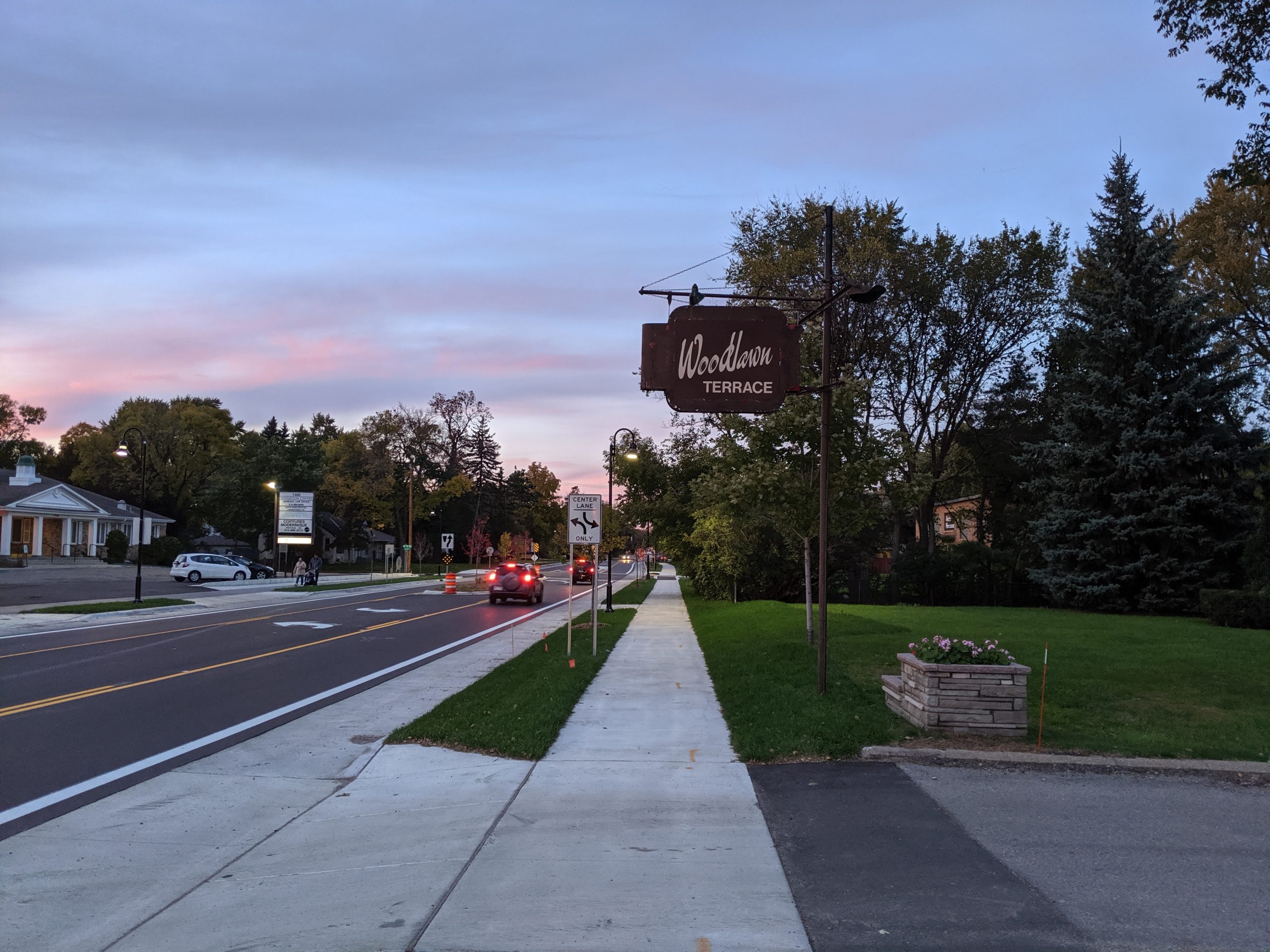
One of the best examples of Richfield working quickly to respond to a resident need was the work in 2021 to preserve the Woodlawn Terrace manufactured home park. While many of these parks have come under predatory ownership that priced out existing residents — or leveled entirely for redevelopment — residents and the park and the city worked together to preserve this unique for-sale ownership opportunity. The city committed $350,000 to utility improvements, and even revised its down payment assistance program to help residents buy a manufactured home. Now under cooperative ownership, land rent is stable and this community has been preserved for the future.
A (original full answer):
As a smaller city with a modest tax base, Richfield often has to be nimble to meet resident needs. A particularly proud accomplishment was the partnership to preserve the Woodlawn Terrace manufactured home community in 2021. Most similar manufactured home communities in the Twin Cities have been lost to redevelopment, losing affordable for-sale housing opportunities. Even more troubling, those that have remained have come under predatory ownership that takes advantage of the ground-lease structure to coerce residents into unreasonably high land rent.
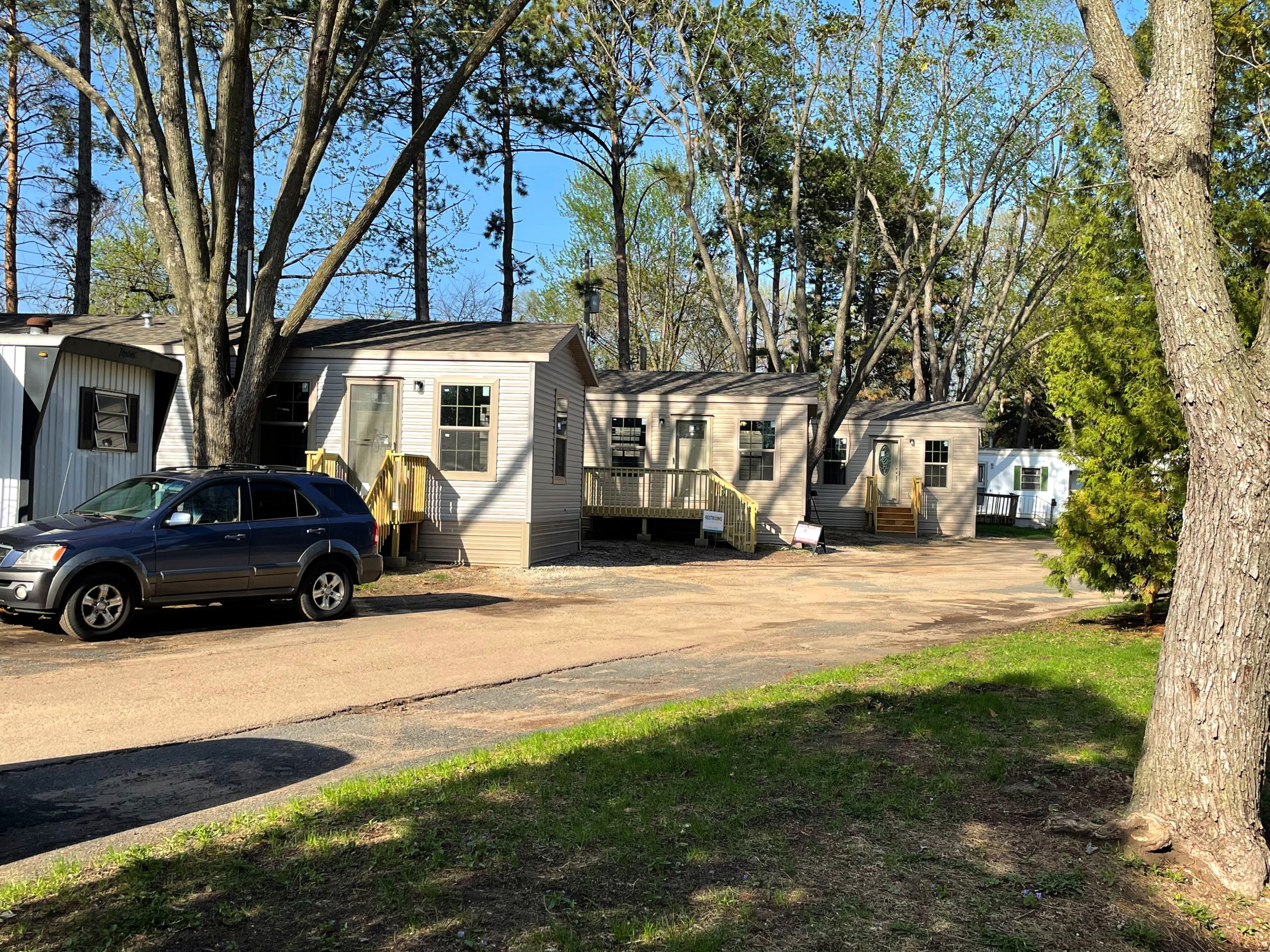
Residents of Woodlawn Terrace banded together to form a cooperative to own the land in the future, in cooperation with the City of Richfield and Northcountry Cooperative Foundation. The City of Richfield committed $350,000 in utility upgrades, helping to connect the 53 lots to the city water system, and to rebuild the internal street system of the community. We also revised our down payment assistance program to allow manufactured housing to qualify for assistance.
Existing residents were able to stay in their homes, older trailers were removed, and efforts were made to bring the community to full occupancy. The conversion was so successful that the former owner of the park moved to a new unit on-site — staying with the property he held for decades. The city continues to support the project by providing a lease of a strip of adjacent park land, allowing larger-sized homes to fit and better serve families.
Q:
What about your town inspires you to keep working to make it stronger? What sets your town apart as truly special? *
A as submitted:
Like many communities across the country, we saw rapid growth after World War II, going from a largely farming community to a dense, gridded city with tens of thousands of residents. But our cycle of change didn’t end there: we’ve continued to change our city to fit our residents’ needs. When the Minneapolis Airport expanded and worsened noise impacts, the City worked to redevelop the areas most impacted. When our streets were no longer serving community needs for walking and biking, we set a new course. When residents demanded greater transparency at City Hall, we changed our procedures and opened the door for more residents to get involved. We’ve invested in important community amenities to help residents of all walks of life. And we’ve done this with broad community support — for example, our 2024 sales tax referendums for new park amenities passed with 2:1 voter approval. Richfield’s history is one of change for the good of our community — and our future is too. I’m proud to be a part of it.
A (original full answer):
Richfield is a community that truly embraces change. Like many communities across the country, we saw rapid growth after World War II, going from a farming community with isolated residential areas to a fully gridded city with tens of thousands of residents. But our cycle of change didn’t end there: we have embraced major redevelopment over the decades — changing our city to fit our residents’ needs. When the Minneapolis-St. Paul Airport expanded and worsened noise impacts to Richfielders, the City worked to redevelop the areas most impacted. When our streets were no longer serving community needs for walking and biking, we set a new course. When residents demanded greater transparency at City Hall, we changed our procedures and opened the door for more residents to get involved.
Richfield has charted a common-sense approach to equity, demonstrating a community commitment to building prosperity without exclusion. We’ve worked to preserve affordability, while embracing growth of our tax base. We’ve invested in important community amenities to help residents of all walks of life. And we’ve done this with broad community support — for example, our 2024 sales tax referendums for new park amenities passed with 2:1 voter approval.
Richfield’s history is one of change for the good of our community — and our future is too. I’m proud to be a part of it.
Gallery
Strong Towns requested 10 photos to represent Richfield. These were the selection:
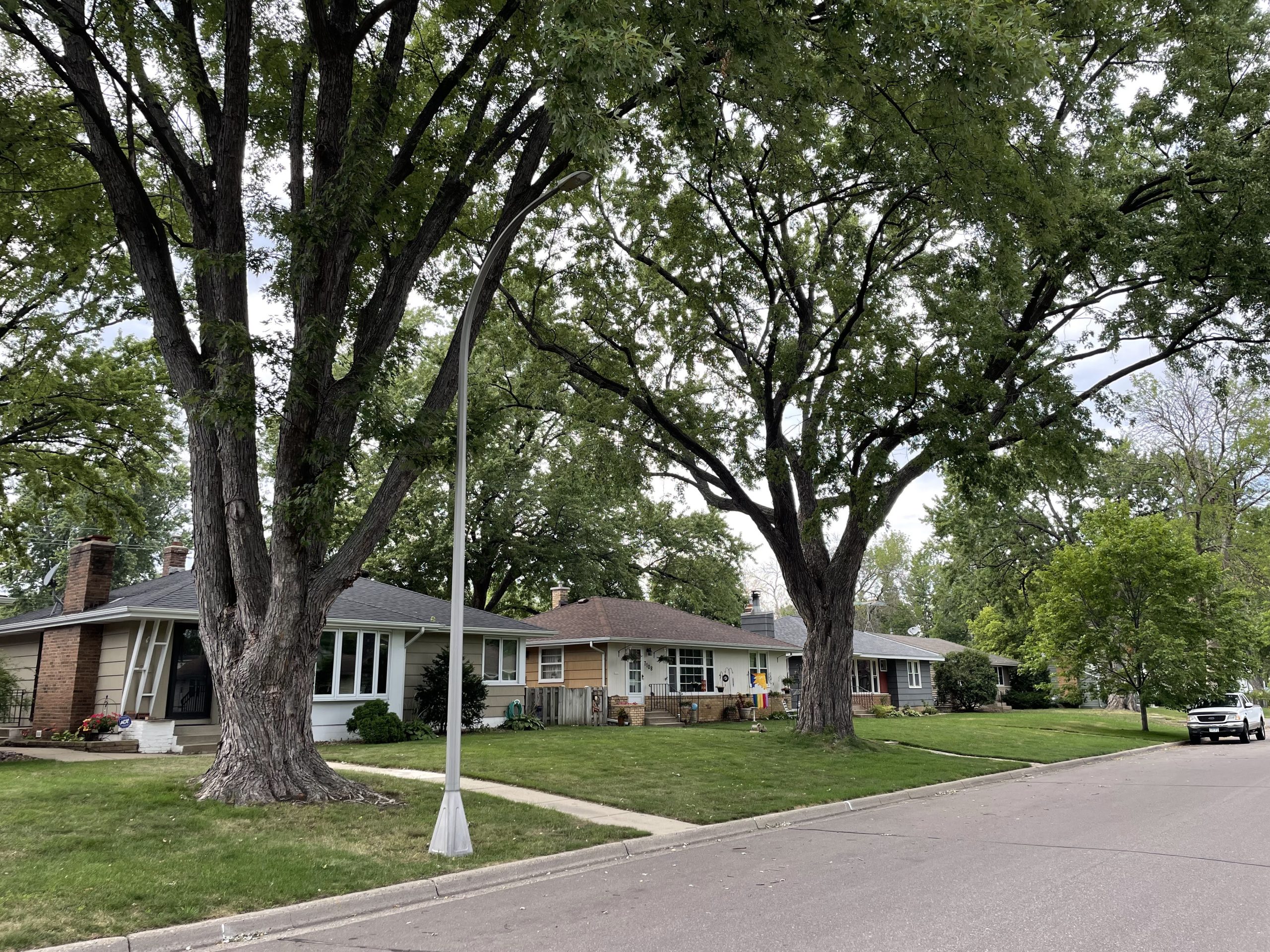
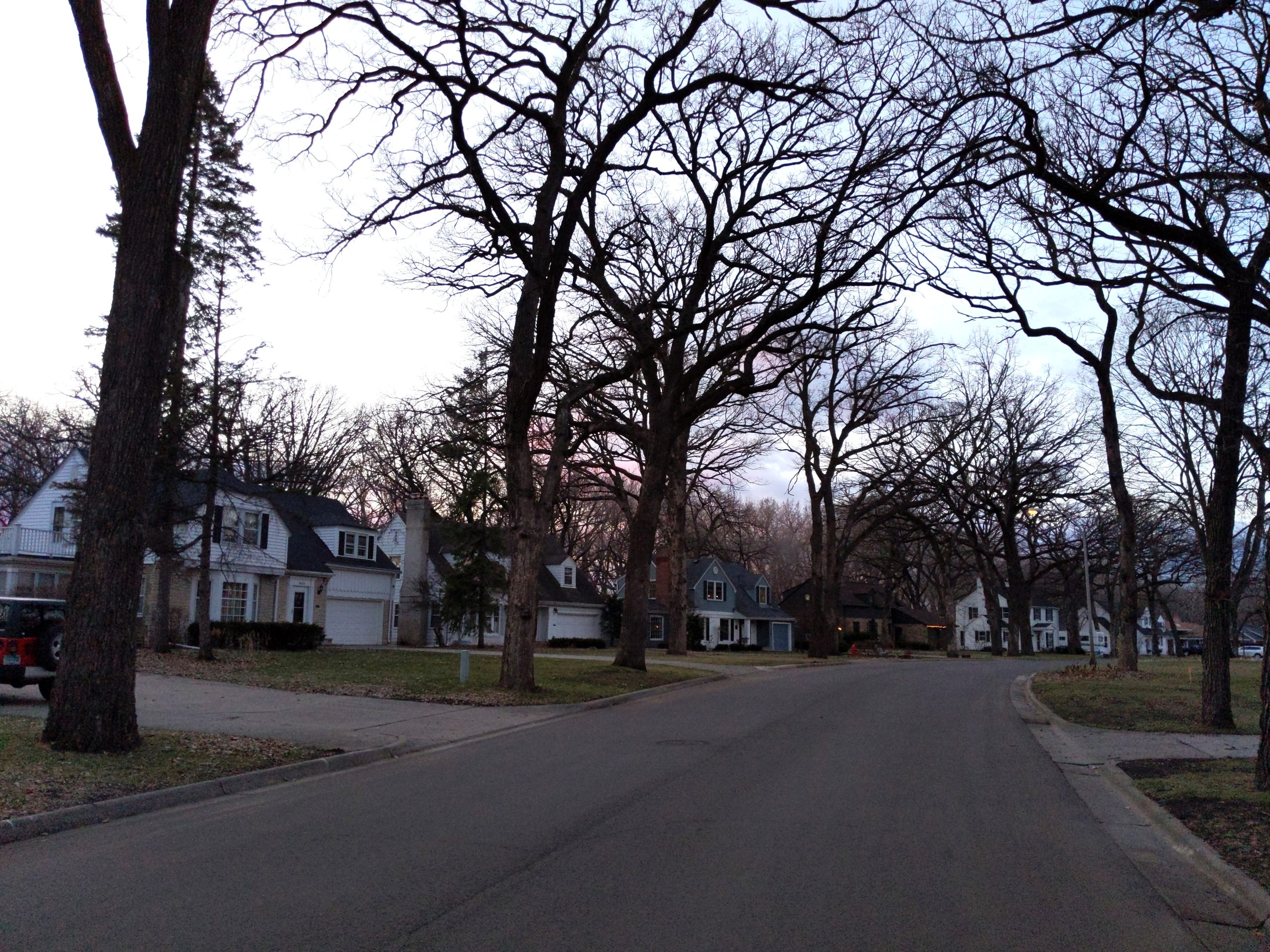
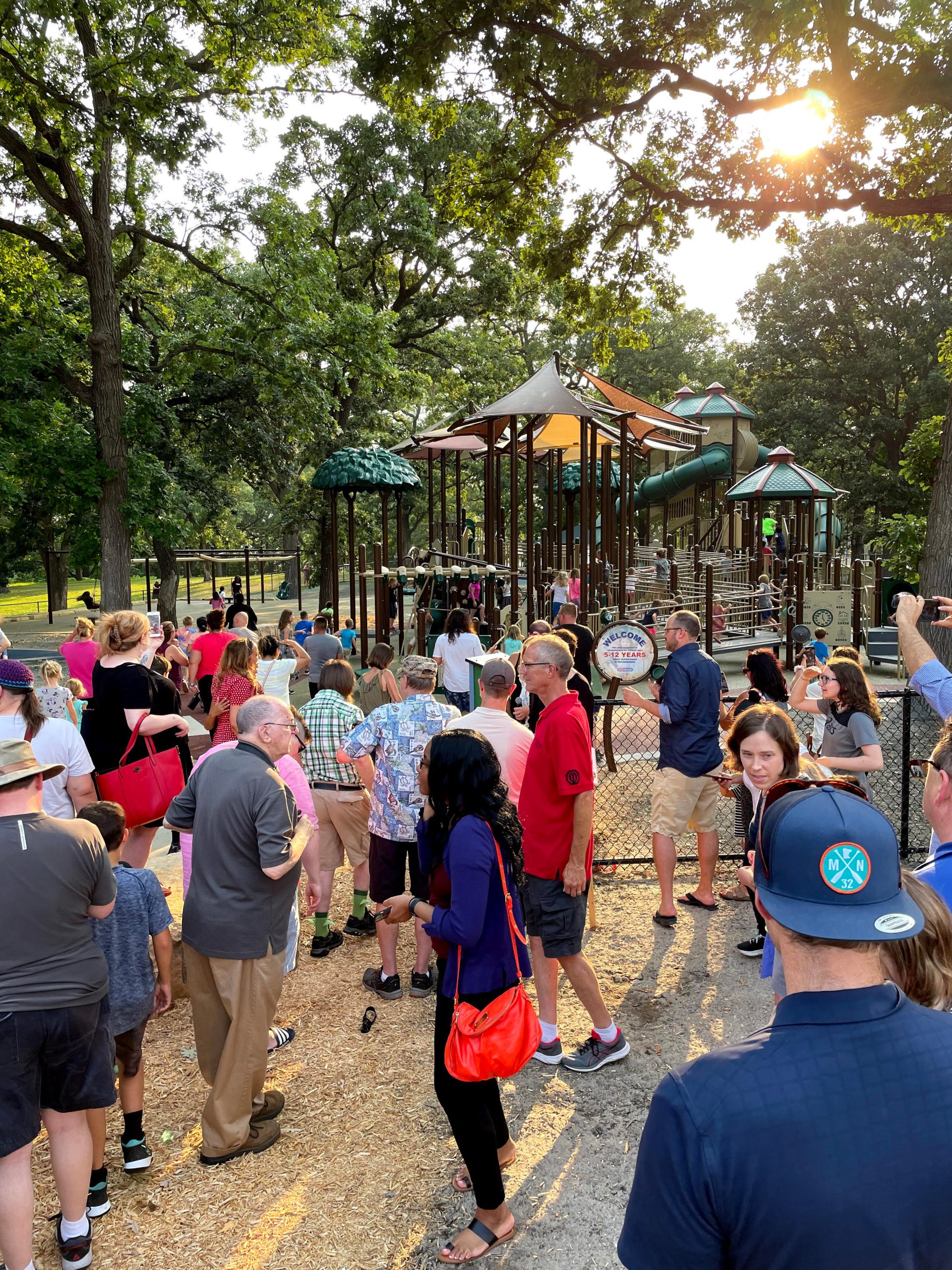
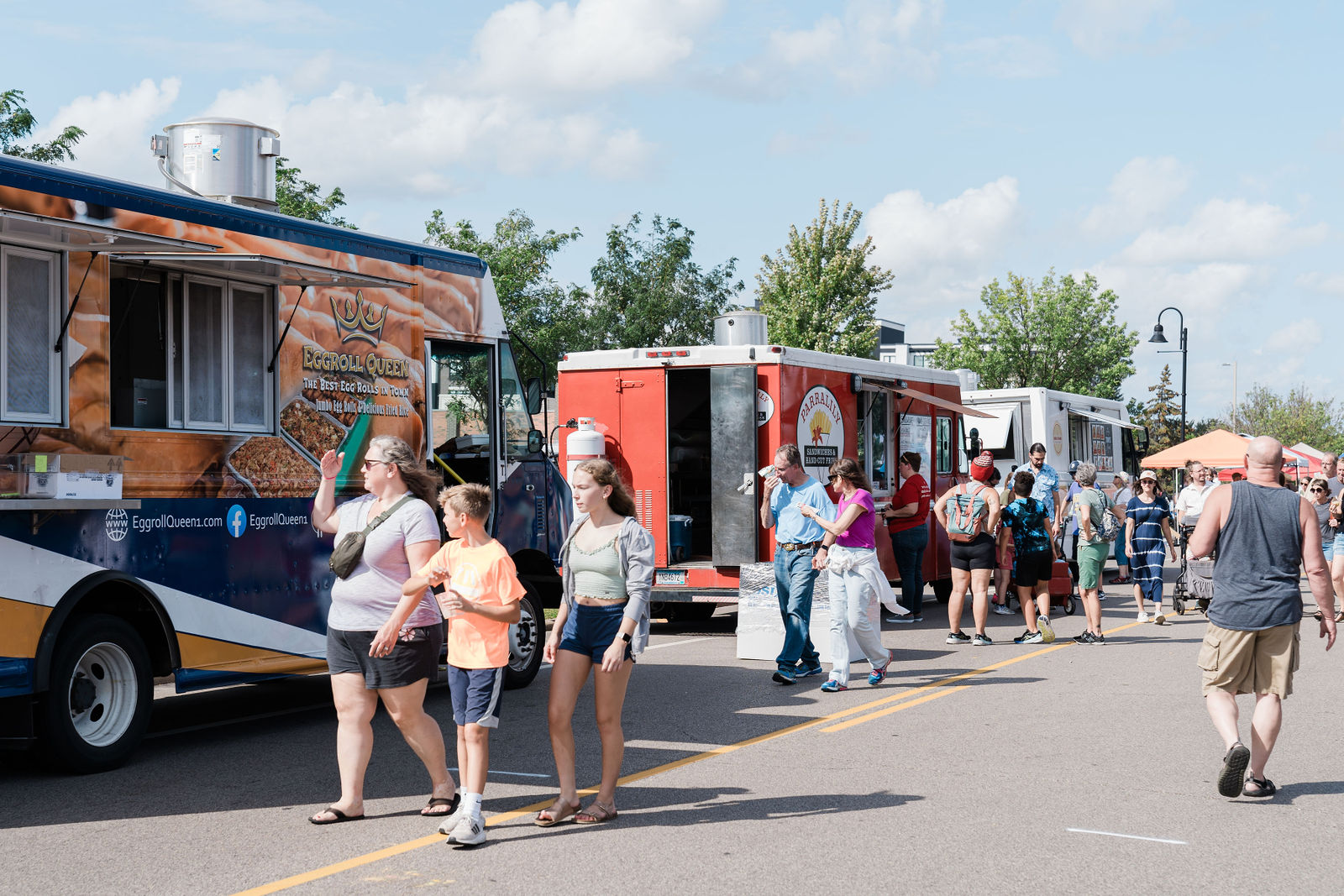
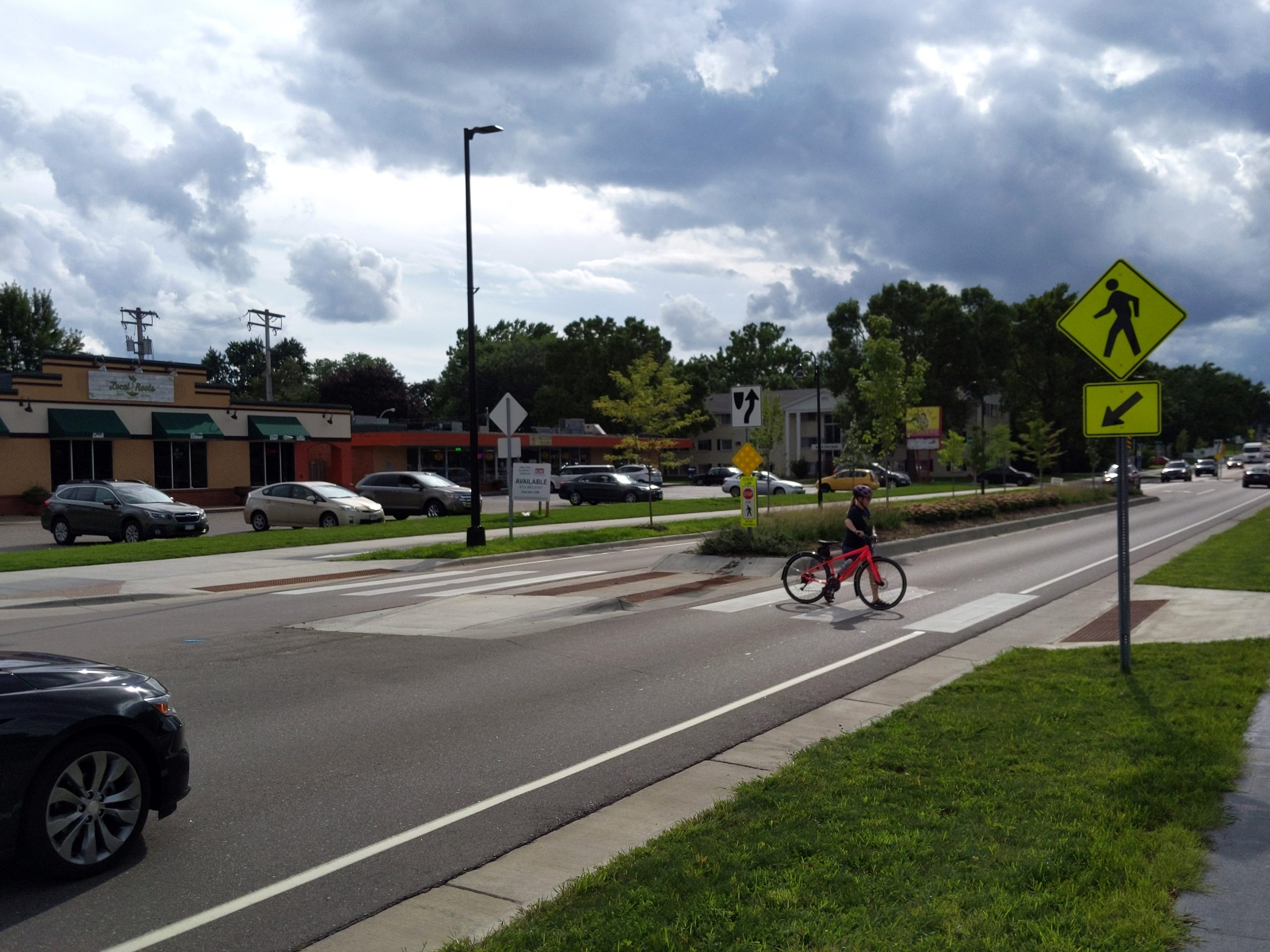
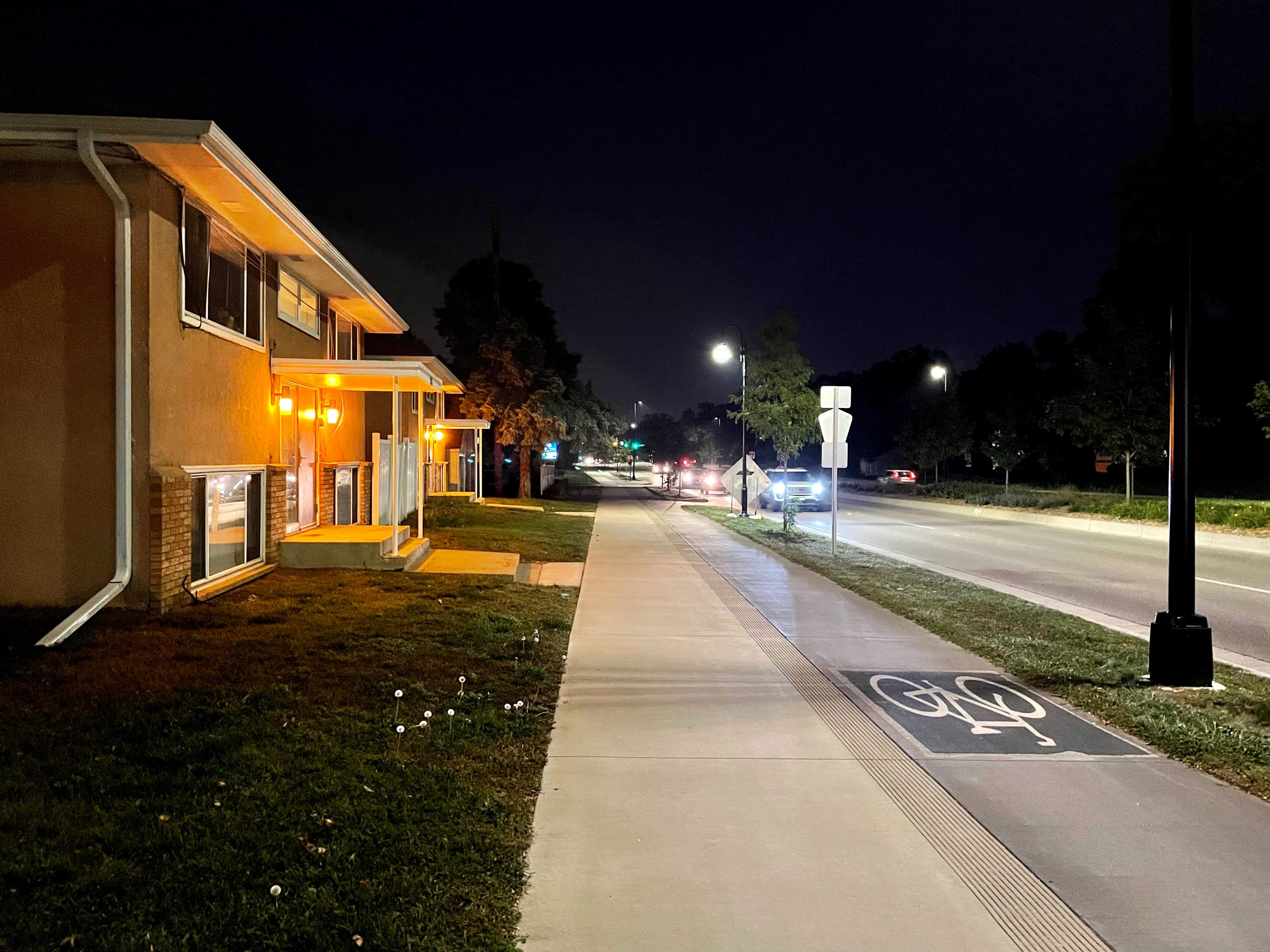
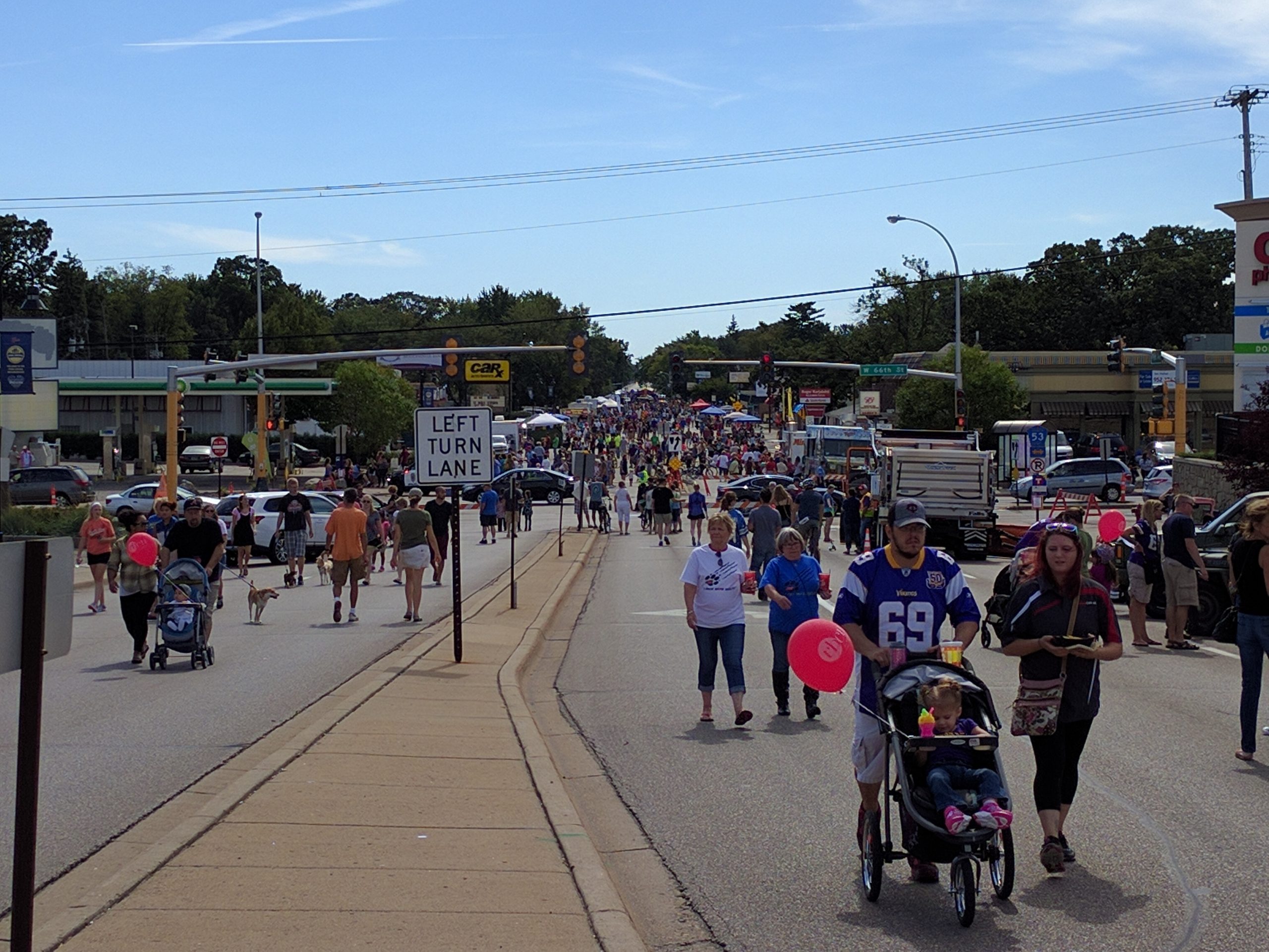
A block of post-World War II rambler/ranch houses, one of the most common housing types in Richfield.Prewar homes in the historic Oak Grove neighborhood.The Woodlawn Terrace manufactured home community along a newly rebuilt Lyndale AvenueNew manufactured homes inside the Woodlawn Terrace communityOpening of the Augsburg Adventure Park, a new fully accessible playground for all.Woodlake Nature Center — a 150-acre nature preserve on the edge of Richfield’s downtown. The nature center building is being rebuilt in 2025-2026, and the new design prioritizes walk-up access for the thousands of residents within walking distance, as well as the three major bus lines that serve the center.A new mixed-use apartment building downtown, alongside a reconstruction of a street for a new roundabout.PennFest, an annual open streets festival put on by the small business district on Penn Avenue. Photo: Rachael Larson.A pedestrian crosses at one of many pedestrian crossing islands on the new 66th Street. Adjacent to a major park, this section of road was previously 4 lanes with no medians, bike space, or greenery.A section of the 66th Street bikeway at night, providing pleasant walking and biking to existing apartment buildings.
Last spring, at a voter forum for Richfield’s west-side City Council seat, there were a number of questions about the mid-century commercial development that lines Penn Avenue between the Crosstown and 68th Street. Voters and candidates spoke of “tired” buildings, non-conforming sites, and inadequate parking. These questions about Penn Avenue seem to come up in every election cycle, and our elected officials are often put on the defense of why there continue to be vacant storefronts, and almost no major redevelopment.
The longer I’ve lived in Richfield, and the more deeply I’ve become involved in conversations around development, the more I have come to realize something: yes, Penn Avenue has all of those “problems.” But many aren’t problems at all. They’re what makes this corridor the best hub of small business in Richfield. And there are better ways to make this area even better.
Small businesses along Penn Avenue
Meet Penn Central
Immediately south of Crosstown Highway, Penn Avenue is true mix of styles and types of businesses. The massive parking lot of the Lunds store is the first thing you’ll see on the west, while the east side is littered with independent small businesses, ranging from Woof Central doggy daycare to Johnston’s Vac and Sew to one of only two classic barber shops in the city. Around the corner at 66th, you’ll find Aida, one of my favorite restaurants in the city.
The distinctive small business district has an informal business association, and has branded their neighborhood as Penn Central. This organization, together with the City, hosts Richfield’s annual Open Streets festival, PennFest.
Open Streets at PennFest
The fact that small business is concentrated on Penn is no accident: these “tired” buildings on small lots are affordable and accessible to small businesses. As a planning commissioner, I have often heard residents share concerns that new development only brings more chains to the community. This, also, is no accident: chains can afford higher rent, and have more specific requirements for their building that are easier to do with new construction.
Cities do not have the right to control if a chain or small business is allowed to occupy a building — but we do make a choice in terms of what environment we want to create. Replacing affordable older buildings with brand-new buildings will have the effect of displacing small business and attracting more national chains. That may be inevitable, but it does not have to be a process we help accelerate.
The Penn Avenue Guidelines are the wrong solution to a problem that doesn’t exist
In 2008, in response to ongoing desires to improve the Penn corridor, the City contracted with an outside consultant to create a new master plan for the area. This process was valuable, and has given us a rigorous, high-quality zoning code for the area, that includes important features to improve the pedestrian environment, ensure high-quality development, and to limit uses that detract from the neighboring properties, like auto sales and drive-thrus.
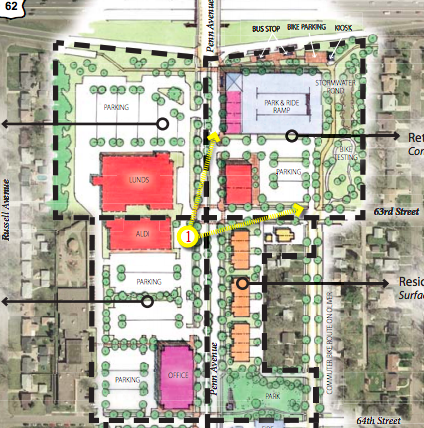
However, the big picture proposed by the plan is disturbing. In a hypothetical redevelopment scenario, the plan envisions every single unit of small, affordable space for small business being eliminated — replaced by larger, mixed-use buildings. Even worse: the plan envisions every single piece of existing naturally occurring affordable housing being replaced.
This is not a good end-goal to have — if we were “successful”, we would eliminate important parts of our local economy, and the exciting, interesting businesses that help make Richfield a great place to live.
With no problem to solve, we don’t need to be desperate
The first project proposed after the Penn Avenue plan was a CVS Pharmacy. This project went against many of the principles of the plan: it was large, single-use retail. Facing the sidewalk, it didn’t offer the customer entrances, display windows, and awnings envisioned — instead it had a large, blank retaining wall, which allowed the parking lot to loom over Penn Avenue. But it was approved, feeling that demonstrating some sign of life would help inspire additional redevelopment.
Since that building was built six years ago, there has been no new construction on the corridor, although most existing businesses continue to thrive. Now, the City is considering an application for the first new development proposed in years: a fast food restaurant. Like CVS, this would be another single-use chain, this time with half the required density, and with a drive-thru speaker that is half the required distance to housing.
Proposed fast-food restaurant space
The Planning Commission, on which I serve, voted against the variances that would allow this fast-food restaurant to build — although it remains to be seen if the City Council will accept or overrule that recommendation. The problems with the development are significant, and it was clear to me as a planning commissioner that they did not meet the specific standards for the variances they were seeking.
In the bigger picture, developments like this fast food restaurant offer little to the community. They are certainly not the high-intensity development that the Penn Avenue Guidelines envision. Occupying a tiny portion of the site, they do not offer much improvement to the tax base. They have significant externalities in terms of noise, air pollution, and traffic. And they replace more-affordable commercial property with less-affordable new development.
How to fix Penn Avenue? Fix Penn Avenue.
Although it offers a lot to the community, there are admittedly problems on Penn: some spaces remain persistently vacant, and the cosmetic appearance of the corridor is poor. If we want to improve the appearance of the corridor, let’s start with something that doesn’t have to cost businesses a dime, and something that we can do right away: rebuild Penn Avenue.
The sidewalk by the Fireside Foundry parking lot is simply an unstriped portion of the lot, made inaccessible by the driveway apron. Image: Google Street View.
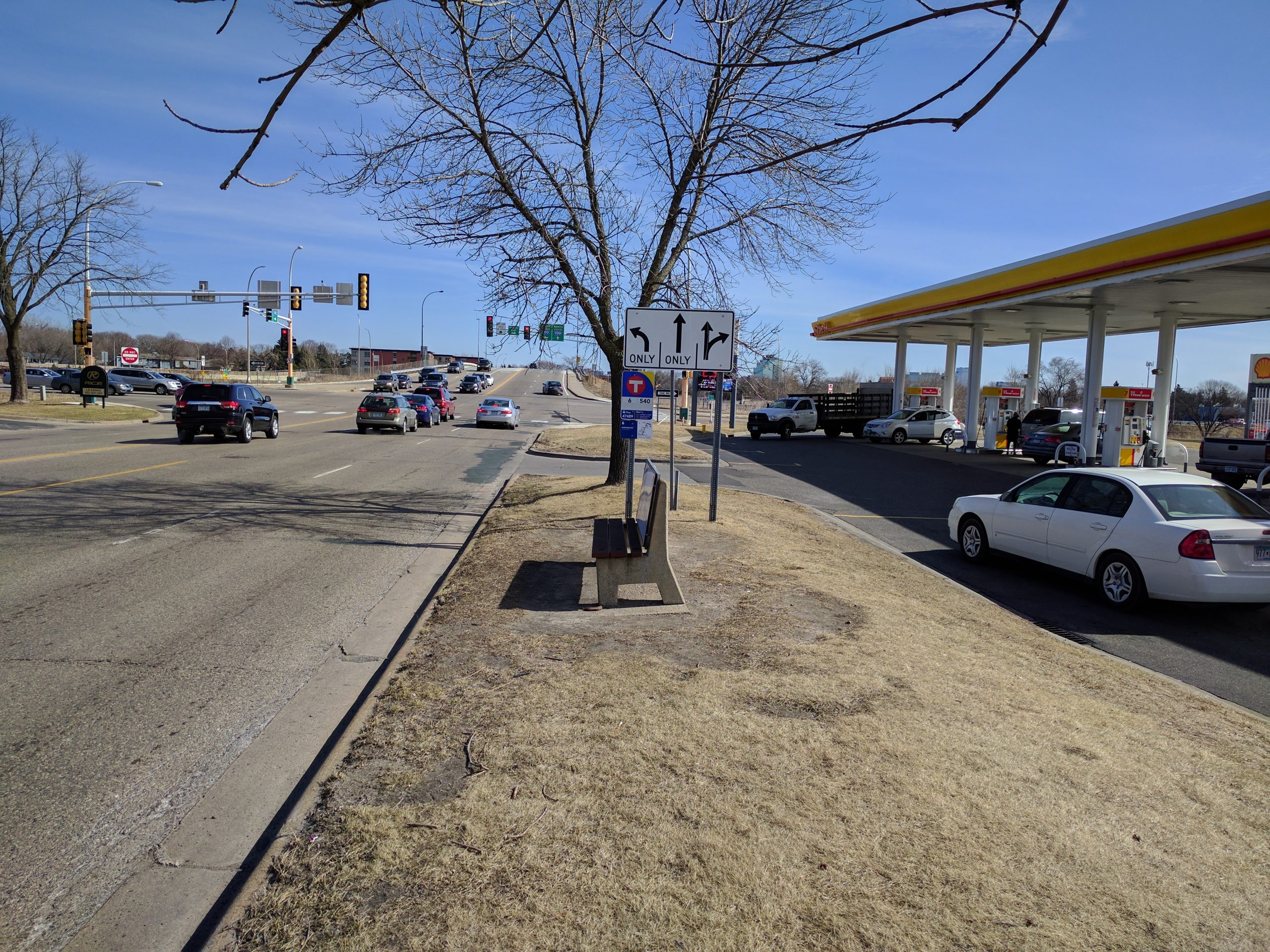
The four-lane death road, owned by Hennepin County, is a grim relic of yesterday’s engineering. Sidewalks are completely inaccessible. Speeding is common. On-street parking that could serve businesses exists for only a single block. Crossing from one side of the street to another — a key component of a walkable business district — is all but impossible.
Let’s not eliminate our small business corridor. Let’s help it thrive, by giving businesses an attractive home, and giving their customers and our residents a safe place to walk, shop, and live.
I spend a lot of time thinking about the 494 strip. I work out of a coworking space near 494 and 100, and live less than a mile north of the highway in Richfield. As a Richfield planning commissioner, I have seen manyprojects revolve around 494 visibility and access. On a broader level, Richfield has ambitious goals for high-intensity development along the strip.
Richfield isn’t alone. The 494/5 commons between the airport and Eden Prairie has one of the highest concentrations of destinations in the region, having been classified as an “edge city” in the planning book by the same name. The Southdale District is a particularly large concentration of development just north of 494. And all three of Bloomington’s “development districts” center around 494.
Congestion
If you talk to the average car commuter about this section of I-494, the first thing they’re likely to talk about isn’t the concentration of destinations. They’re likely to talk about the congestion. The area immediately around 35W experiences over six hours of congestion per day. The only solution to this problem? More lanes, and better interchanges.
Building more lanes will kick the can down the road for another few years, but it doesn’t address the fundamental problem: each city wants to build high-intensity, auto-oriented destinations along a highway that will only get more congested.
After decades of drawing attention to the matter, we have made no serious progress on expanding 494 or the the 35W interchange. If we’re lucky, we’ll get $75 million for a partial improvement to westbound 494. But what then? 494 will hardly become uncongested — even on day 1 of an improved interchange. And if the cities along the strip achieve their goals, much more traffic will continue to pour onto the freeway.
Pentagon Park
To get a sense of just how intensely new development wants to add to traffic congestion on 494, check out this staff report on Edina’s Pentagon Park, which includes a consultant’s report describing the local street improvements needed for the development to move forward. Among the changes needed:
Additional southbound lane on France Ave
Double-left turn lanes at nearly every signal within a mile’s drive of the development
Upgrading the existing 5-lane 77th Street Bridge over TH 100 to a minimum of 8 lanes.
Despite the detailed, comprehensive vision on the auto improvements needed, this is the entirety of what they describe for bicycles, pedestrians, and transit:
This lacks the rigor of the auto analysis, and fundamentally assumes one thing: nobody walks.
They key problem with this section of France Avenue? Not enough lanes. Image: Google Maps.
Transit viability
For an auto-oriented strip, 494 has reasonably good transit options. In addition to express routes to downtown and the future Orange Line near 35W, 77th/76th St and American Blvd both have all-day local bus options. But the streets are not set up for the walking and biking needed to actually use transit. And development often turns a blind eye to people walking or arriving from transit. As a result, even achieving the live-work mixes we hope to add in the strip, few would choose to use transit if they have the option to drive their own car.
Even the new Lyndale Ave interchange provides a noisy, stressful pedestrian experience.
Including walking, biking, and transit
To grow the 494 strip to cities’ goals, we need to rethink our approach to development and the streets in the corridor. I fully expect that developers’ main interest in 494 will be driven by its high auto traffic. But cities need to channel that interest into something that works for a multi-modal future. Cars are a big part of that future — but they can’t sustain 494 alone.
I was up in Brainerd this weekend, visiting my sister. I’ve been up there several times since she bought a house just south of downtown a year and a half ago.
Downtown Brainerd in November 2014. Photo by author.
Brainerd has a nice, walkable downtown. It has wide sidewalks, trees and benches, and active storefronts. Compared to the neighboring Baxter strip, it’s a breath of fresh air. But how to get downtown?
Meet 6th Street
The main north-south spine of Brainerd is South 6th Street, which formerly carried Highway 371 (and still marked as “Business 371”). And it’s by far the most direct option to get downtown for anyone living in the south-central section of Brainerd:
November 2014. Technically, there was a sidewalk underneath that snow. Photo by author.
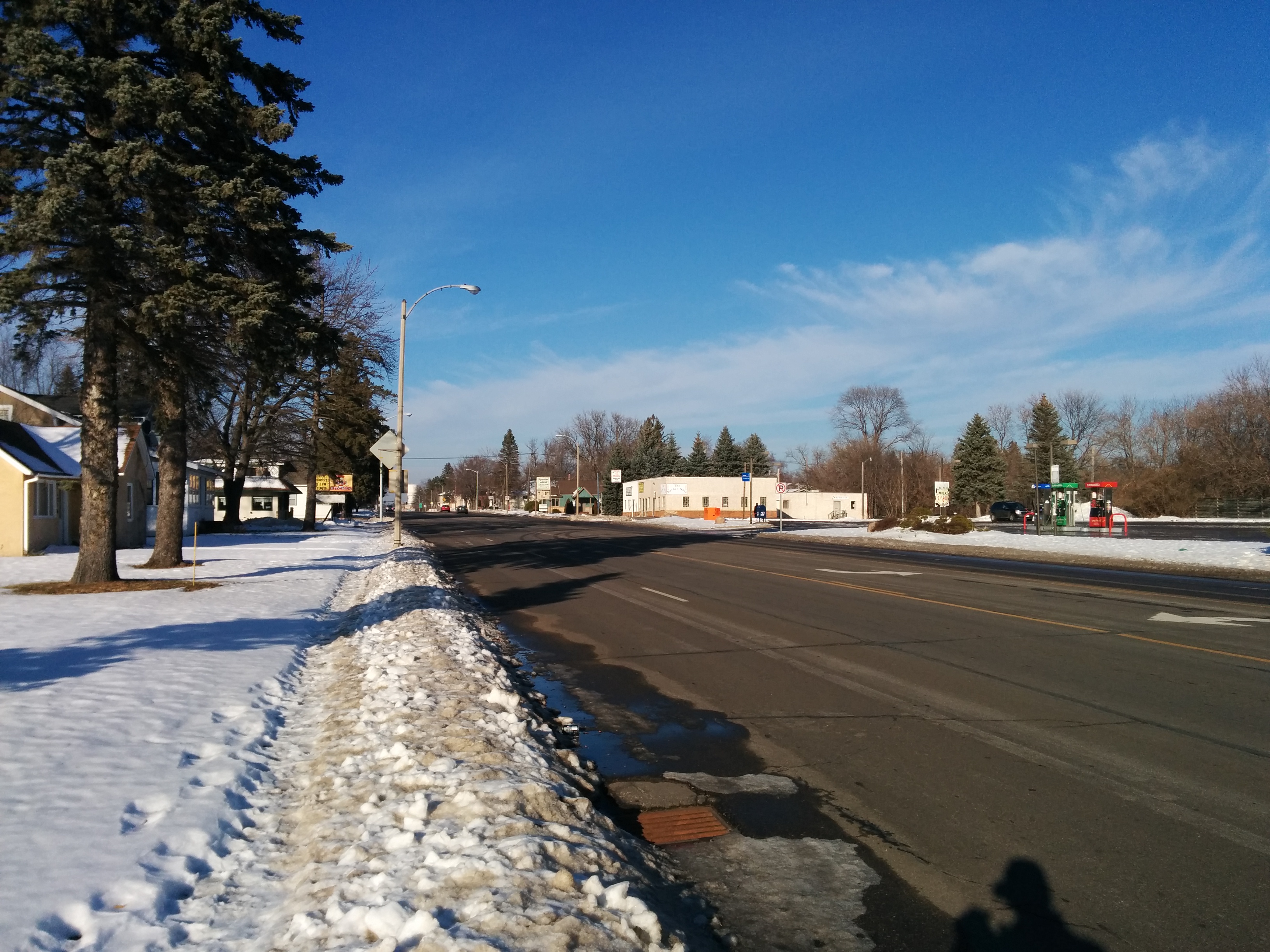
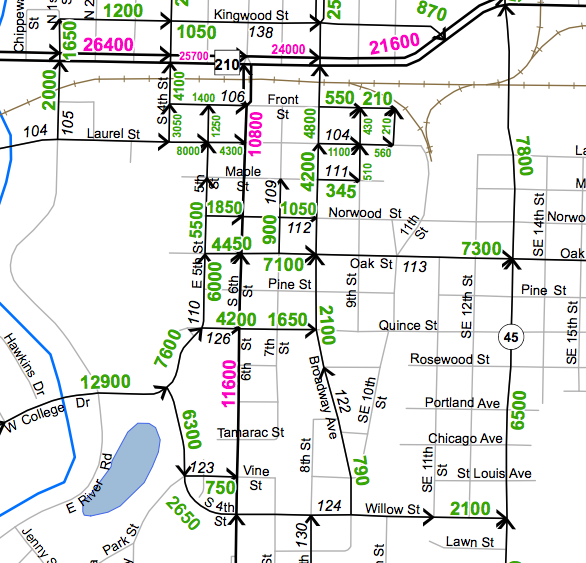
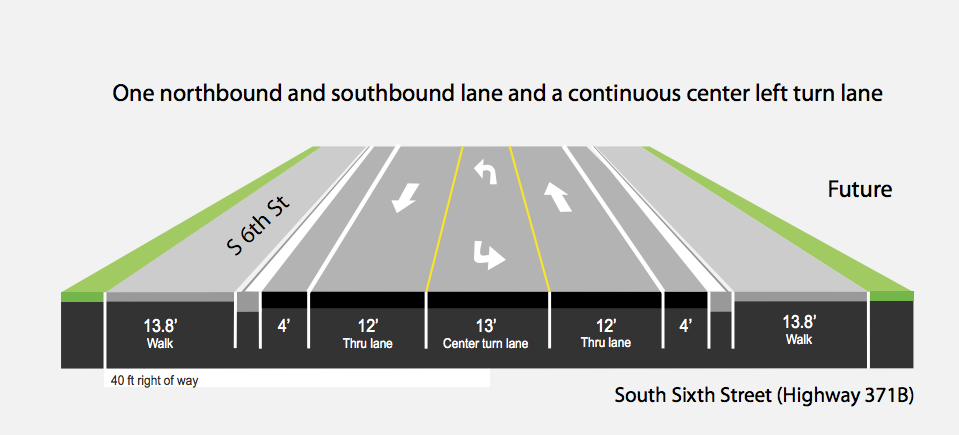
It’s a wide, five-lane stroad, with no parking, few trees, little lighting, and narrow sidewalks. It skimps on everything but number of lanes and width of those lanes. Currently, the four travel lanes are 12′ wide and the center turn lane is about 14′. All this for traffic volumes that barely scrape 10,000:
The bad news is Marohn’s efforts didn’t seem to be in line with the Brainerd City Council’s actions. For the most part, Brainerd chose the 5-lane section — widening the street out to 5 lanes and making it more pedestrian-hostile as it approaches downtown. Even the 3-lane section that is being built (south of Quince St) is shockingly unambitious. Despite many indications that 10-11′ lanes are the safest for calming traffic (and even very car-oriented engineers preferring 11′ lanes), MnDOT’s plan offered the community 12′ travel lanes and a thirteen foot center turn area.
6th Street 3-lane section
Opportunities for planting along the corridor appear to be unseized, but that could change. However, since the sidewalk narrows to 9′ north of Quince, trees likely could not be sustained near downtown.
Why would a city do this –throwing away an opportunity to transform one of its most important streets, all for nonexistent traffic?
I wrote the Brainerd City Council in November asking them to support a 3-lane design. The only response I received is revealing. After expressing concern about possible cut-through traffic from a calmed 6th Street, this Councilman went on to explain:
Business 371 is named for that very reason. For business.
We also have a lot of future growth to deal with. For a example [sic] there are 640 acres own by the Mills family for residential housing just southwest of Brainerd that will have high traffic counts when it gets developed.
Business 371 needs to be five lanes.
I won’t opine too much on the Councilman’s response, since just about everything I could say has been expressed many times by Strong Towns. But, in short: we should sacrifice the town we have today, in the hope that we will one day be able to encourage more traffic to serve new greenfield development. A symbolic gesture that I’m sure was intentional, he did not once refer to 6th Street by its local name — only as “Business 371”.
A larger failure
Wasting an opportunity to seriously improve 6th Street is disappointing for Brainerd, but I find it even more troubling about what it says for MnDOT.
Ostensibly, Minnesota has a Complete Streets policy. So does Brainerd (adopted slightly after the decision to support an incomplete 6th Street). So why would MnDOT even offer such a bloated option to a local community? And why would even the “road diet” version offer proportions that are dangerously wide and encourage speeding?
Unfortunately, I don’t know the answers. But I do know that this project represents nothing good about MnDOT’s ability to implement Complete Streets.
Note: I chair the Richfield Bike Advocates, and represent that group as a non-voting liaison to the Richfield Transportation Commission. However, I am not speaking on behalf of either group.
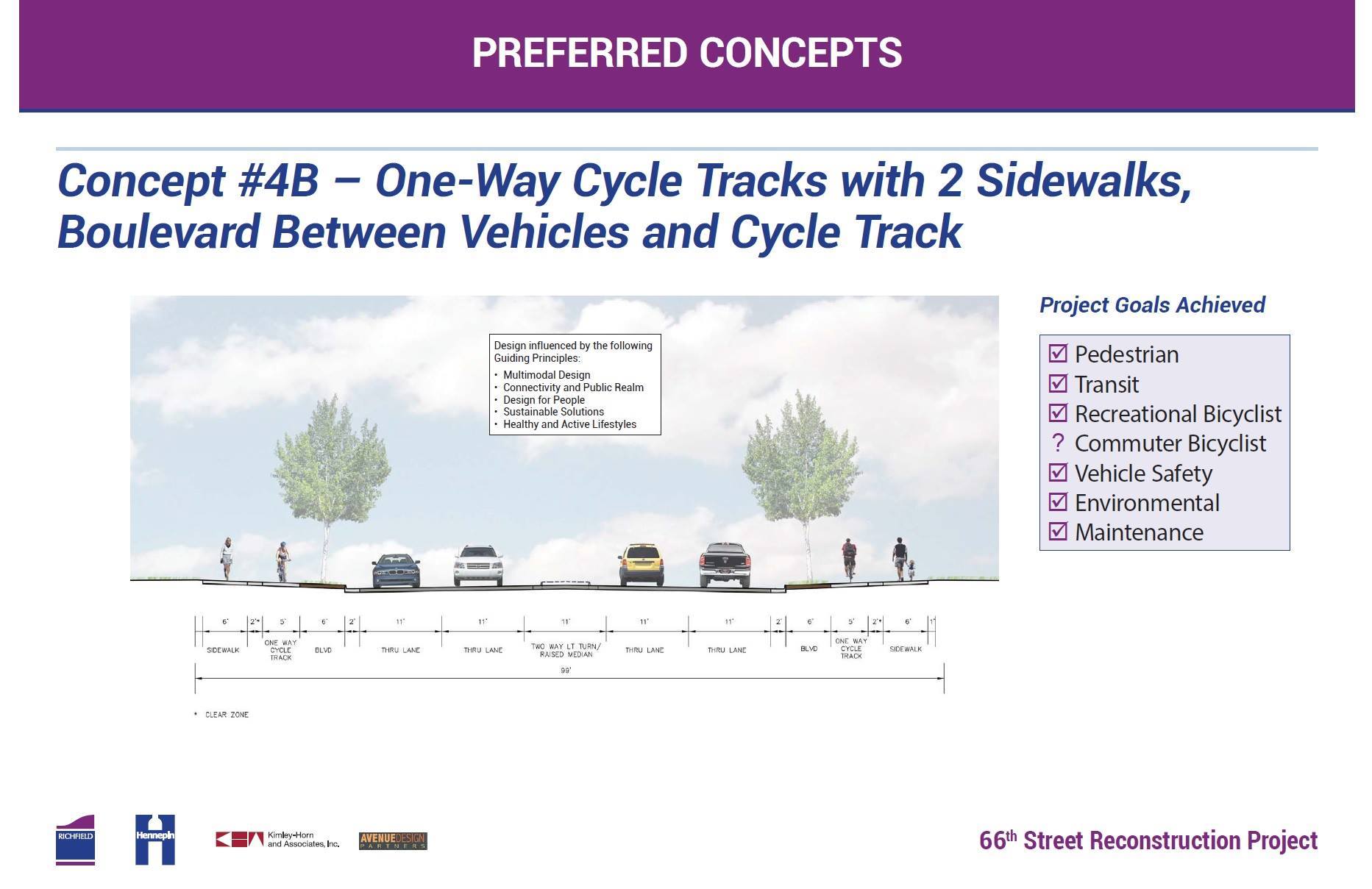
Tonight, the Richfield City Council will make a major design decision that will affect more than 20,000 people every day. The City Council will consider whether or not to approve Concept 4B for 66th Street between Penn Avenue and 35W (already approved from 35W to 16th Avenue). The design features wider sidewalks, boulevards, protected bike lanes, and (likely) planted medians.
Concept 4B, approved by Transportation Commission from Oliver Ave to 16th Ave
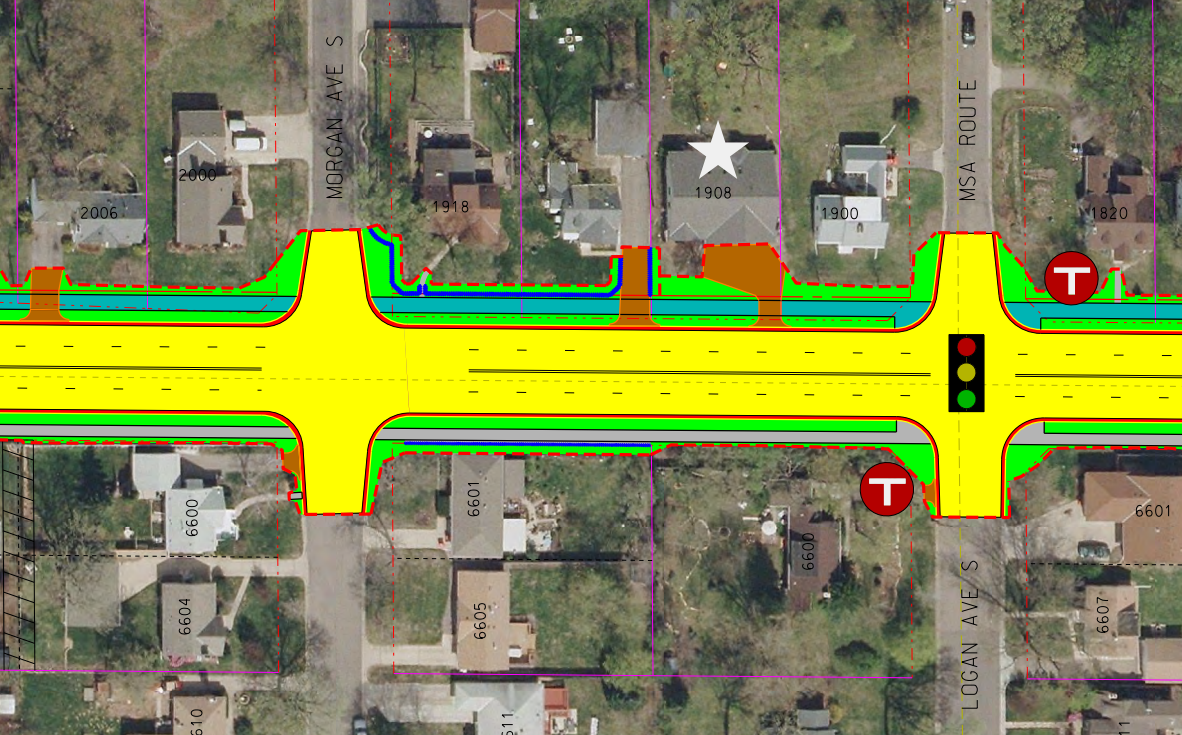
This concept represents community consensus of how our major streets should work, and also meets Hennepin County’s demands for auto capacity (four through lanes). But there’s a catch: it doesn’t fit. The new street would be about 100 feet from the the outside edges of the sidewalks, while the existing street fits tightly in the 66′ right-of-way. To make room for the new space, eighteen homes will have to come down on the south side of the street.
There are a lot of obvious conflicts here: Hennepin County demanding 4/5 auto lanes, while Richfield might find three acceptable. Bicyclists asking for dedicated space on a roadway, requiring width that doesn’t exist currently. Homeowners adjacent to the street, some of whom strongly wish to stay in their homes, while other groups vie for the land. But there’s an underlying conflict: the old school of thought, who likes 66th Street the way it is, and perceives its future as solely a piece of automotive infrastructure. The new school of thought isn’t satisfied with the 1958 design, and sees it as having potential for something more, as a space that serves everyone, and as a symbol of community.
Guiding Principles and a New Vision
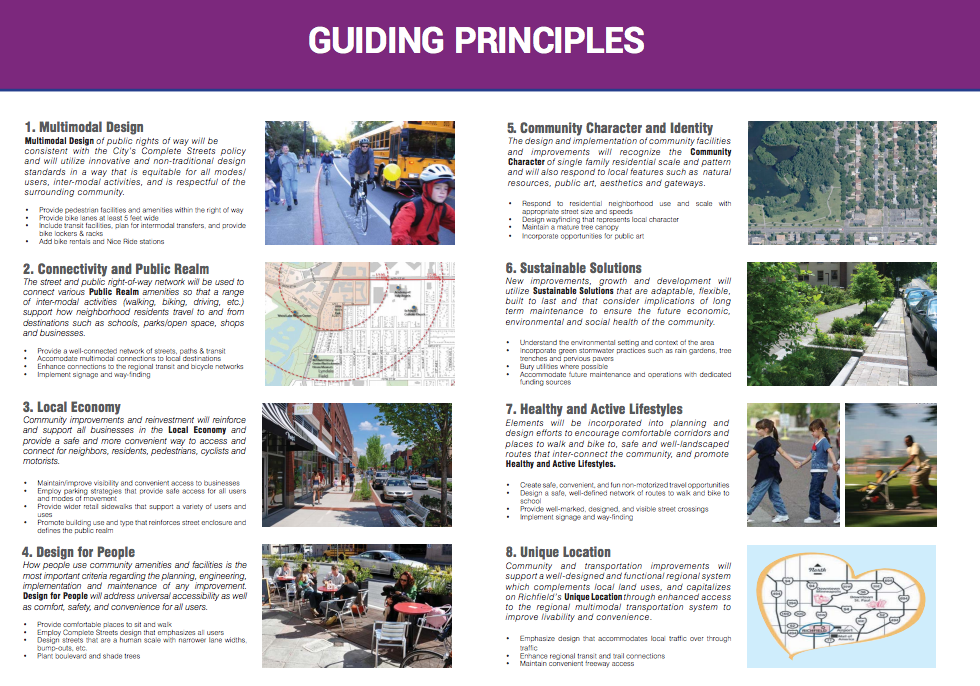
The Transportation Commission recommended approval of Concept 4B in their November meeting, but that was only the most recent decision in a public process that has lasted over two years. The first step was a task force that developed “Guiding Principles” for street reconstruction — the first of which was multimodal design.
Richfield guiding principles
The Guiding Principles are a terrific vision, but they lack balance with the auto infrastructure concerns. Not a thing in the Guiding Principles document mentions automotive capacity. Is this because we’re designing it first as a public space, and only as the very last consideration taking cars into account? Probably not. Rather than addressing how the two might interact, the Guiding Principles seemed to have an implicit understanding that any and all of these community priorities may be overridden as needed for the flow of automobiles.
Yet the Transportation Commission and city staff have stood behind the Guiding Principles throughout the project. There has also been a second set of goals they’ve stood behind, that the proposed street should be safe and practical for pedestrians, transit, recreational bicyclists, commuter (transportation) bicyclists, (motor) vehicles, environmental concerns, and roadway maintenance. Commissioners have repeatedly emphasized that the street built today will likely outlive most of the people making these decisions, and that we must see this as a 50-year-plus commitment.
Practical, Cynical, or Barebones?
Not everyone has been as eager to rebuild 66th as a complete street. Around last summer, criticism came in heavily toward the possibility of removing 18 homes to make way for a wider 66th. Homeowners west of Penn Avenue — who would have had right-of-way impacts, but would not have had any risk of their homes being taken — were particularly strongly organized against the widening. (They were ultimately successful, in that the proposed design does not include a bikeway west of Penn.) Homeowners whose homes were on the line between Penn and 35W were also concerned. One of those stories was even documented in the Star Tribune.
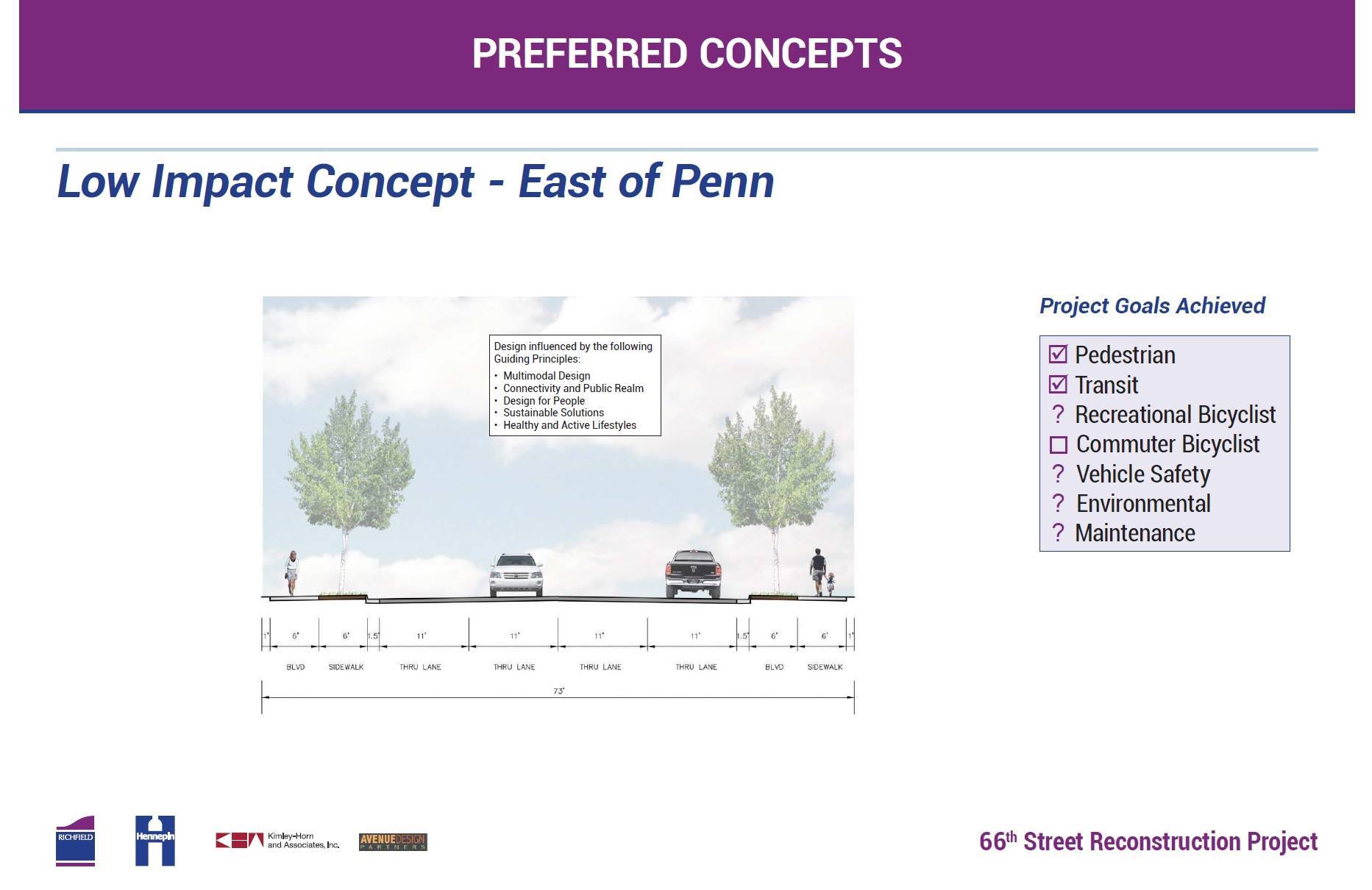
City staff came up with a concept they called “low-impact”, which was essentially a copy-and-paste of the current street, plus some trees:
Low Impact Concept for 66th
Some city leaders initially praised the concept, as did local reporting. And city leadership’s support for keeping the street more-or-less the same didn’t stand alone. A homeowner who lives west of Penn on 66th Street — apparently not considering bike or pedestrian safety improvement to be safety improvements at all — said in a letter to the editor:
The terms “safety,” “green space,” “maintenance” and “planning for the future” have been used to justify this $40 million project. Safety is a subject everyone is concerned with. […] Instead of addressing that problem we are going to reduce lane size, add cycle tracks, walking paths and biking paths.
Since property has been taken from residents twice when the road was previously widened, further possession for bikes, boulevard and wider sidewalks would encroach upon the privacy of taxpaying residential owners.
I’m disappointed that Mayor Goettel and Councilmember Elliott are supporting a plan for the reconstruction of 66th Street west of Nicollet [sic] with no option for bicycles. This isn’t a frivolous extra for a few people to get exercise; 66th is a vital corridor for the north half of Richfield. It’s the only place to cross 35W north of 76th Street, and right now it might as well be a stream of lava as far as bike safety is concerned. I don’t see anything in the “scaled-back” plan to fix that.
After five open houses, comments solicited from the general public seem to follow similar trends. Many wanting major improvements to change the way the street works for all users, while some truly believe the best approach is to fix what’s in place. One resident writes:
I support the proposed concept to bring the best for all modes – pedestrians, motorists, bicyclists and think this is a very forward looking plan which will serve Richfield for many years into the future.
Is Tearing Down Homes Consistent With Goals?
One of the criticisms of the project that seems the most profound and simple is this:
I agree that a 66th Street for All at the expense of your neighbors is baffling and wrong.
Is it? It certainly could be. But if it is baffling and wrong, who’s to blame? The 20,000 cars, many of whom use 66th as a reliever for the Crosstown Highway? The engineers who say that there is no way the cars can function in three lanes? The bicyclists who want to be able to ride along the sides? The pedestrians who require sidewalks?
Despite going into the 66th Street project knowing that homes would have to be torn down to make improvements, this issue was never addressed in the goal-setting. Nor was the more general issue about balancing automotive demands and community demands.
So for now, we’re left between two camps. One who sees the purpose of the street only to move cars, and who thinks it basically works well today. And the other that sees the street as drastically deficient, a relic of a bygone time that will not serve a multimodal future.
Tonight, for at least this one segment of one street, we will see with which camp Richfield’s leaders most align.
If you are interested in attending:
Richfield City Council Meeting — December 9th, 7:00pm Richfield City Hall 6700 Portland Ave S Richfield MN 55423
Streets.mn Editor’s Note September 2020: The article below has been referenced in a political flyer in a Richfield city council race. The flyer has the headline of “Tear down the 77th Street Sound Wall?” The article does not propose tearing down the 77th Street sound wall. Questions can be directed to either candidate.
If there were tenets of belief of urbanists, renunciation of stroads would surely be one of them. As transportation facilities, stroads are ugly, dangerous, and create incentives to drive a car, with disincentives to do anything else. As a tool of development, they fail to create value in their corridor in the same way a street would.
One block north of the I-494/MN-5 commons, Richfield’s 77th Street is a stroad unlike many others. On the one hand, the stroad is quite aesthetic, and provides a relatively good pedestrian experience. On the other, it’s further divided the community it runs through, and failed to promote desired development along the corridor.
The Stroad
The roadway itself is unremarkable. It’s a 35-40 mph 5-lane divided stroad. But just beyond the curbs, there are some important differences The north side has a tall, freeway-style sound wall (behind which lies single-family homes). The south side has a conventional sidewalk and business frontage, as well as Richfield’s largest concentration of low-income, high-density housing.
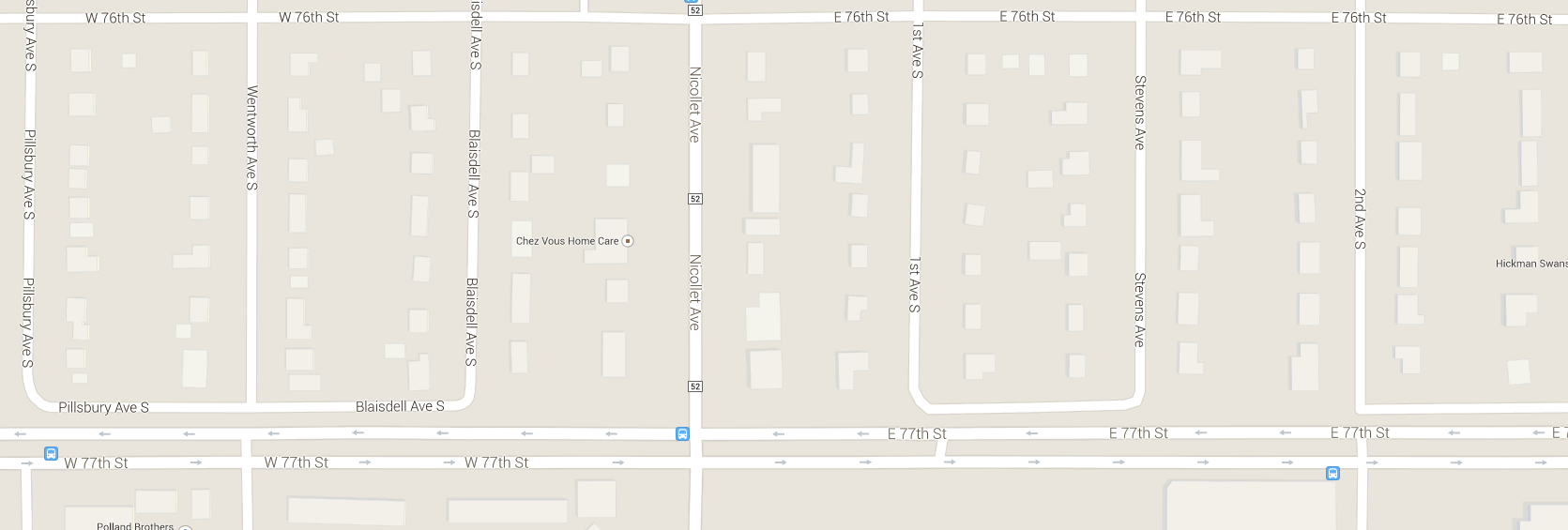
The grid stops short of 77th Street.
The other major difference is that this stroad was built in a traditionally developed context. To the north, the Minneapolis grid runs almost intact. This means at least 12 intersections per mile — and more conflict points if you consider possible alleys or driveways. To create a safe and pleasant environment for cars, this had to be addressed. Richfield’s Director of Public Works Mike Eastling, who was also with the City at the time of the 77th Street project, gave me background on the project. In the 1980s and early 90s, the City of Richfield purchased more than 50 properties along the north side of 77th, to create room to widen the street and a loop system of frontage roads. The actual road construction occurred in 1993.
The road has a nicely planted median, and is ornately planted on the roadway side of the sound wall. These plantings are maintained by the city, paid for by special assessments to businesses along the corridor.
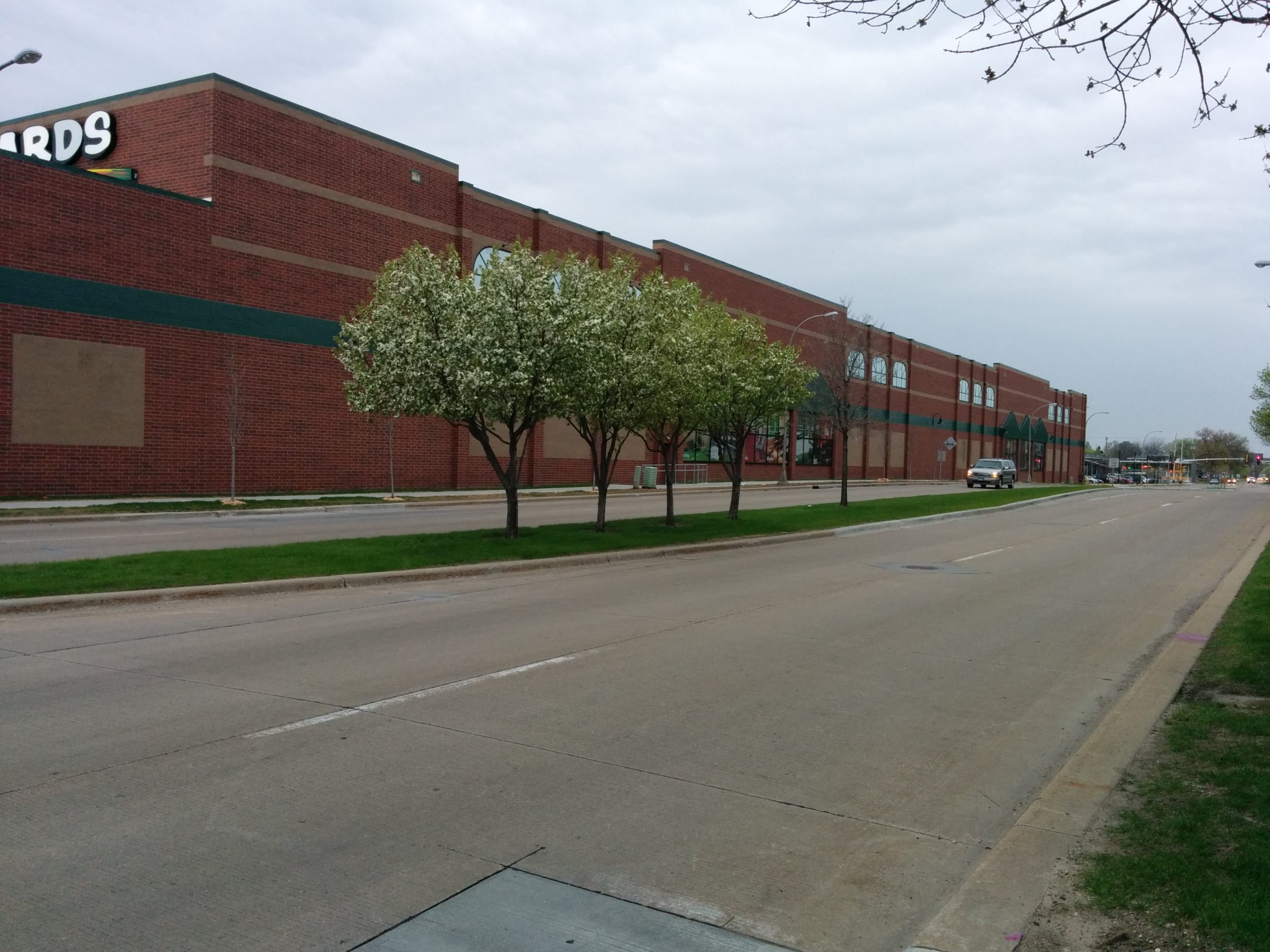
The view from the bus stop. Flowering trees in bloom by Menards.
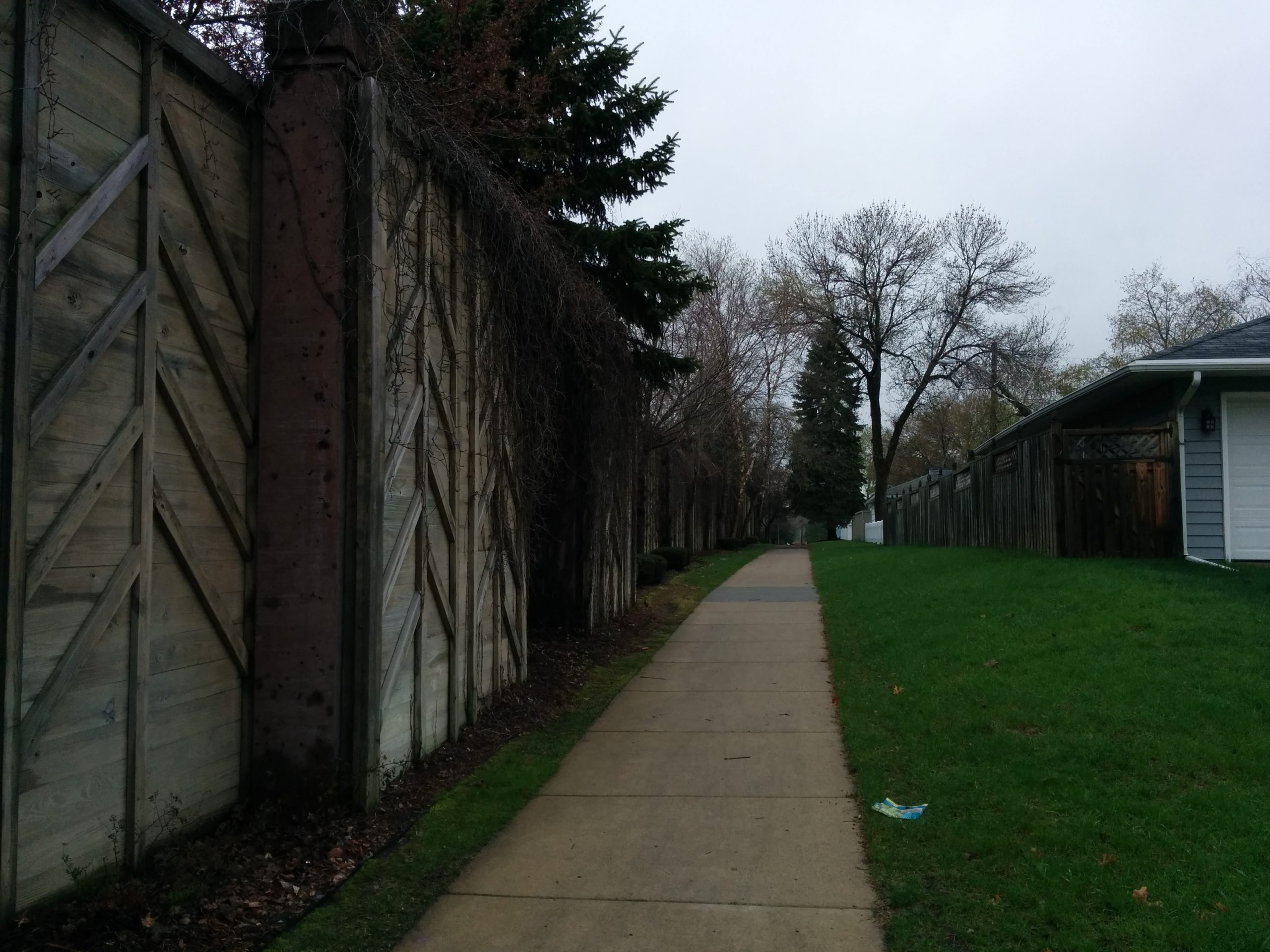
Along the north side of the sound wall, sidewalks connect between the “loop” frontage roads, so there is a continuous path for pedestrians. Unfortunately, pedestrians must walk in the roadway where the frontage road is present — and pedestrians go down to roadway level, rather than creating a more obvious shared space. Pedestrians are considered, but the experience is discontinuous, at best. There is also a conventional sidewalk with a 6′ boulevard on the south side of the street.
Sidewalk along the back side of the sound wall
The People
According to Eastling, the sound wall and removal of access for minor north-south streets were necessary to balance a city pursuing large, highway-scale development and resident concerns. Unfortunately, the only resident concerns accounted for were those of longer-term, single-family-home residents on the north side of the street. No attempt was made to manage sound or other impacts on the multi-family housing, either from I-494 or 77th.
This isn’t troubling just to consider the differences in the types of housing, but also the types of residents. Richfield’s median household income overall was $50,000 in 2011 — with one census tract as high as $105,000. In the main residential area south of 77th Street, the median income is $27,000 — half the city’s median. While Richfield is about 60% white, this area represents about 70% persons of color.
The wall is not an absolute divide between these worlds. There are periodic crosswalks, in addition to the major through streets. (One can cross at about every third or fouth block.) But it is a troubling symbol of divide between two very different communities.
The Lost Urban Village
77th was designed to serve freeway-oriented business, and it does a good job of this. Eastling actually made a good argument on this point, arguing that — while Richfield is a generally urban community — this is a very suburban, freeway-oriented corridor. And it needs a suburban, car-oriented street to serve it well.
Other issues with 77th notwithstanding, this is a reasonable way to approach the question. Maybe 77th Street does work. Maybe it keeps traffic off of 76th, a recognized new Complete Street. And maybe the value it creates is enabling highway-oriented business to efficiently transfer auto-driving customers.
Unfortunately, this is not the official vision of the community. Enter the I-494 Corridor Land Use Plan, a part of the adopted Richfield Comprehensive Plan, and probably the most universally ignored planning document in the city’s history. The plan strives to promote high-density, mixed-use development, that both serves cars but also creates a “pedestrian-friendly environment” in a “vibrant urban village.”
The closest development to the plan is Kensington Park and Mainstreet Village at Lyndale and 77th. On their face, they do a pretty good job. Kensington Park in particular has well-concealed parking, a mix of different housing types, and excellent frontage along Lyndale Ave and 77th.
However, the details show something else:
Chipotle (in Kensington Park) lays out the red carpet for pedestrians entering from the vibrant urban village.
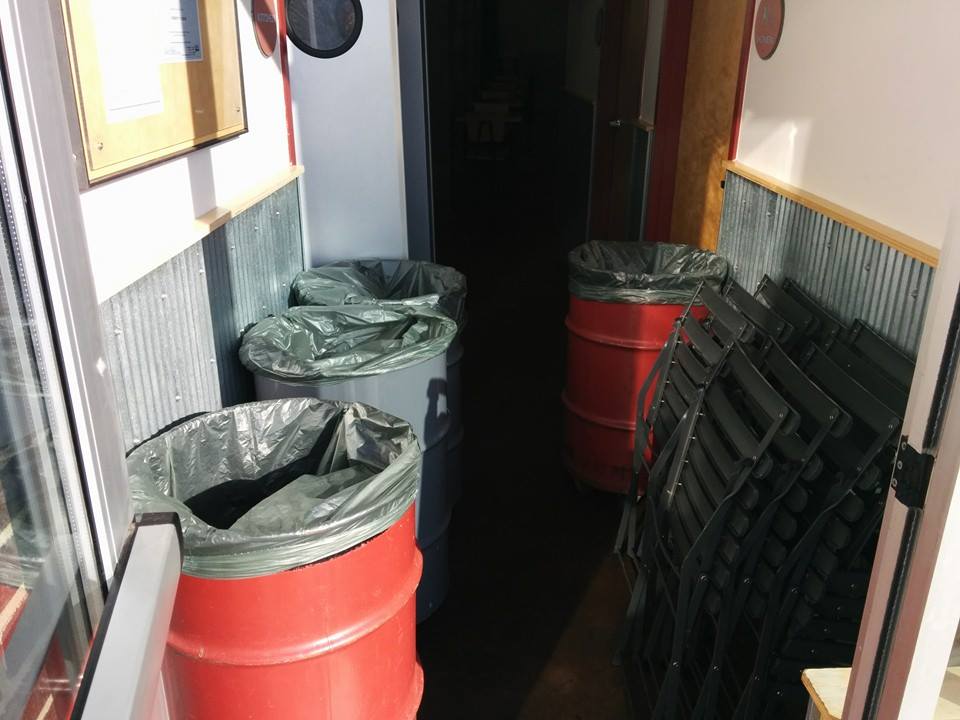
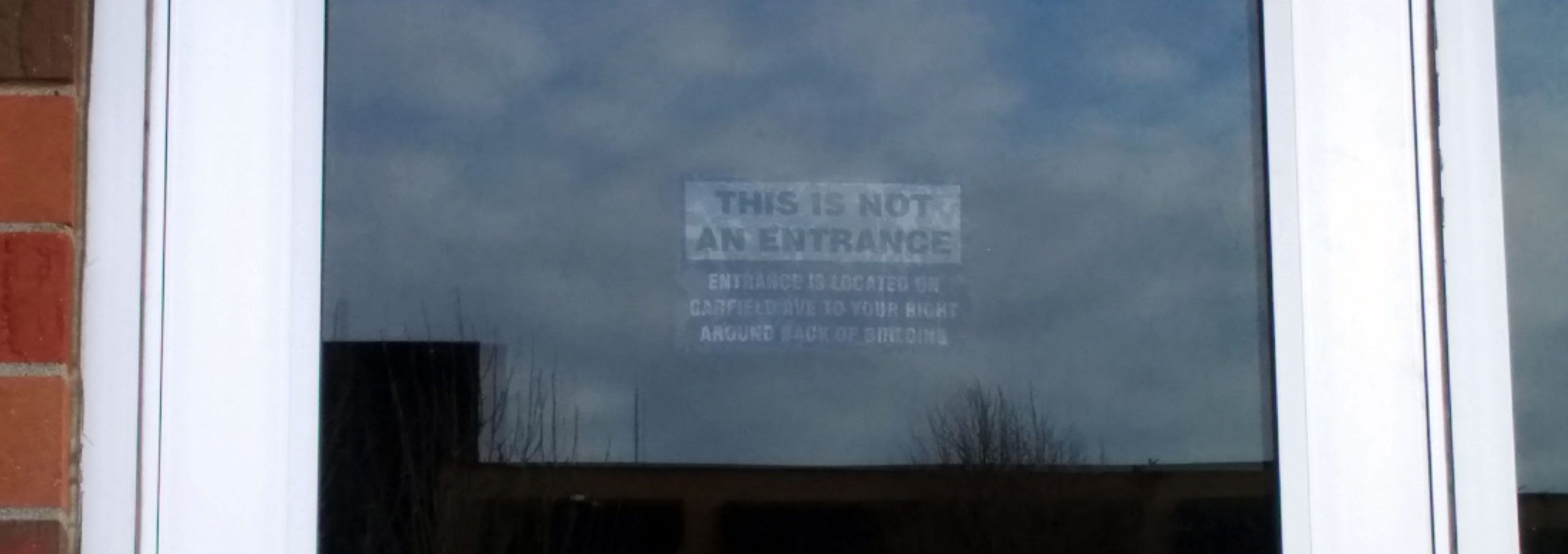
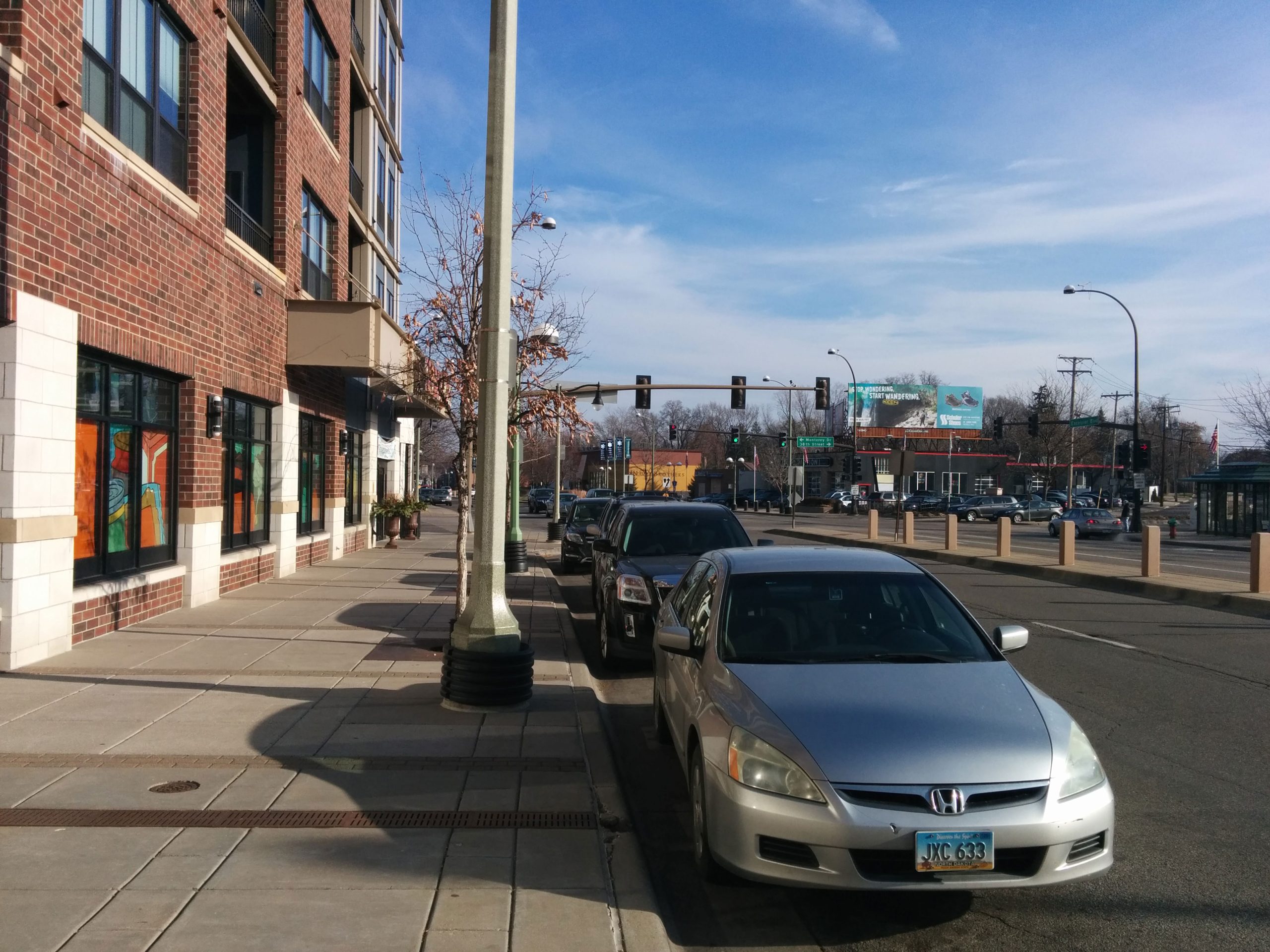
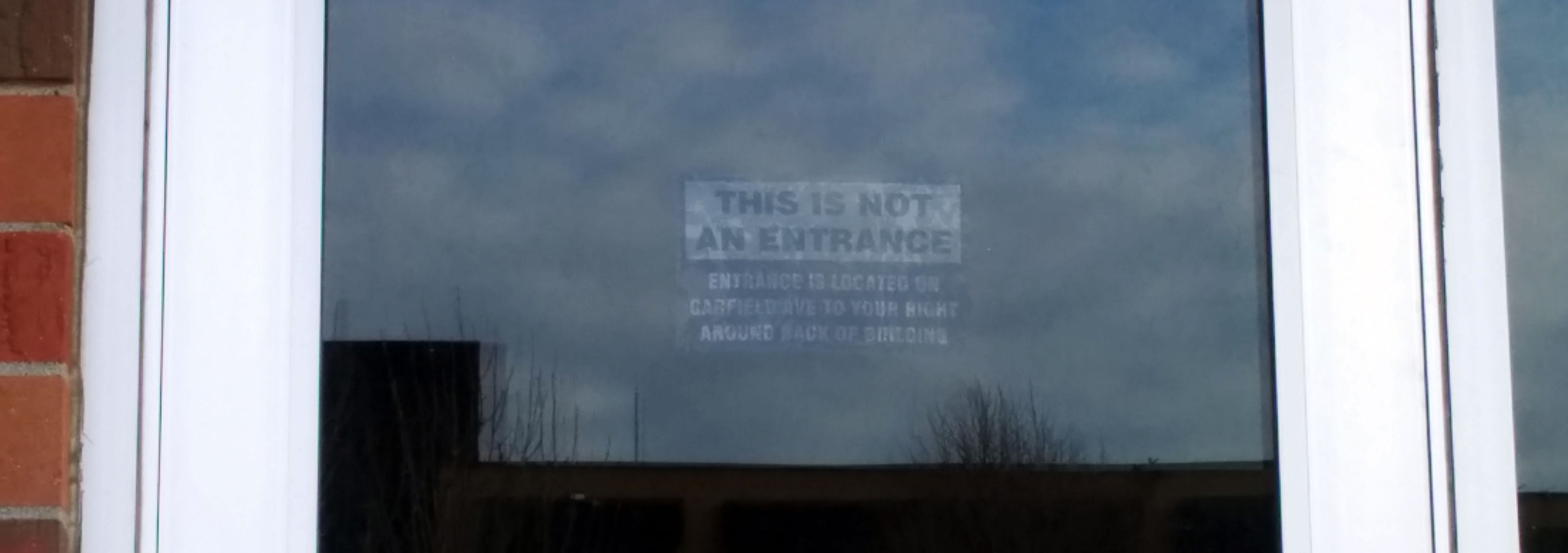
Street entranceNot Entrance to the Mainstreet Village office.
Even when the planning and orientation are done well, the businesses occupying the space still focus almost exclusively on cars and parking entrances.
On the other hand, sometimes the planning and orientation are also terrible:
Corridor Plan: “While parking is critical to the success of any future development in the corridor, it should not be a dominant land use seen from the public environment.”
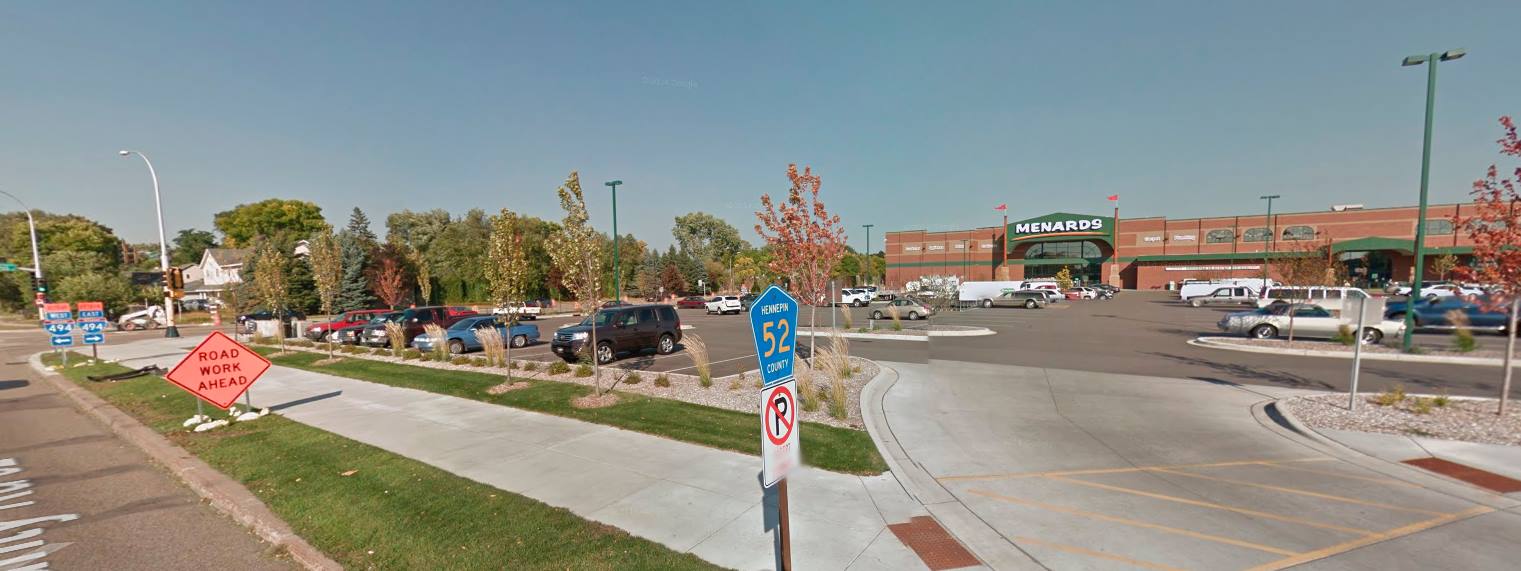
The Menards at 77th and Nicollet — constructed several years after adoption of the 494 plan — contributes nothing to the goal of the “vibrant urban village”. It is a single land use that occupies nearly three full blocks, including a block of parking at the one of 77th’s most important corners. In deference to the 494 Corridor Plan, Menards did install some (now-dead) trees along the edges of the parking lot, and some billboards along 77th to avoid a blank wall.
Eastling may be right — the 494 corridor is inherently suburban and auto-oriented. In this case, 77th Street is doing a fine job, and the development along the corridor is acceptable. On the other hand, if we are to believe in the vision of a “vibrant urban village”, development along the corridor has failed dramatically, and 77th Street is contributing the failure. Either way, the street creates a distinctive divide — between different demographic groups, between different street grids, and between different eras of the way we build our cities.
66th Street is Richfield’s main street, and with a planned reconstruction of 3.5 miles in 2016-17, it has the power to transform this first-ring city. It also has an enormous influence on adjacent South Minneapolis: 66th Street is the longest east-west street south of Lake Street, as well as home to the only major bus line south of Lake. (That bus line also happens to be the only Hi Frequency bus line that does not enter Minneapolis or St. Paul.) Although these transportation aspects are important, the most important aspect in terms of Richfield’s future success is not a question of how many cars, bikes, or buses move on 66th Street. Rather, the most important aspect is something that’s been overlooked in the street planning process so far: the quality of the frontage along it.
Before I go any further, I will note that you have a major opportunity to help create a vital, urban 66th Street by attending the upcoming open house, which will help determine bicycle facilities for the new roadway:
Thursday, May 1, 2014 4:30p-6:30p Woodlake Nature Center 6710 Lakeshore Dr (walking distance from buses 4 and 515, and only 3 blocks away from the Bryant Avenue bikeway)
A Postwar World
Although Richfield is laid out on a prewar grid, the majority of its development came after 1950. Remarkably, some areas haven’t changed since. Behold, 66th and Nicollet, home to the Hub:
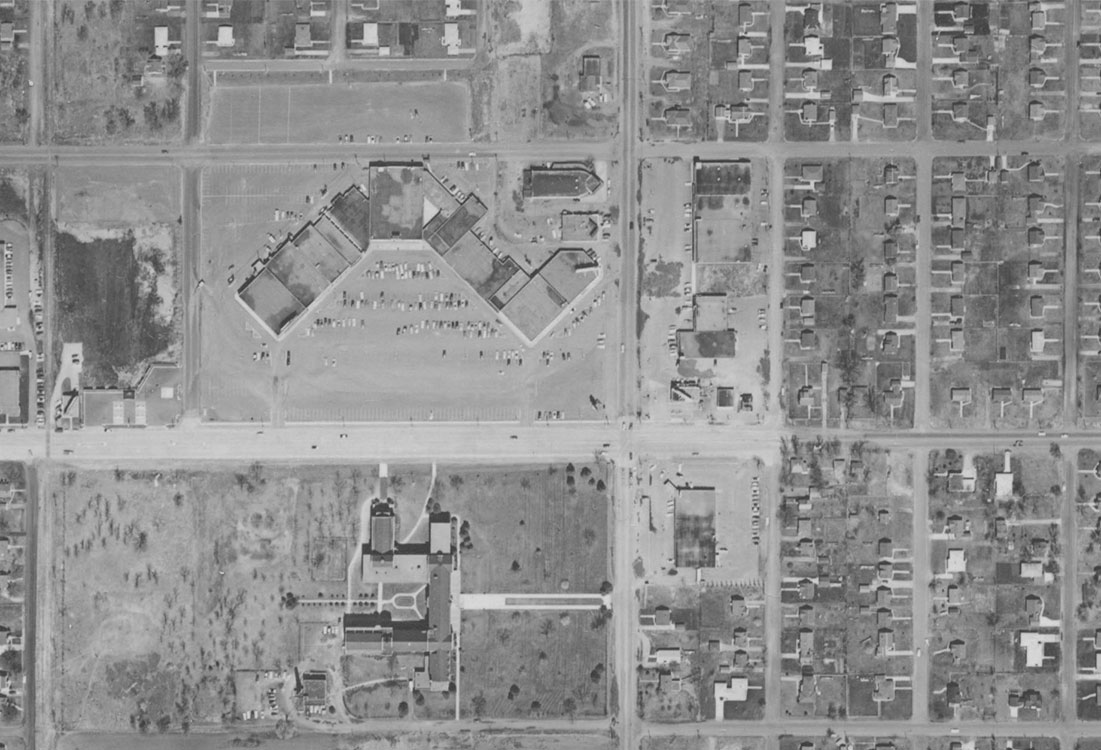
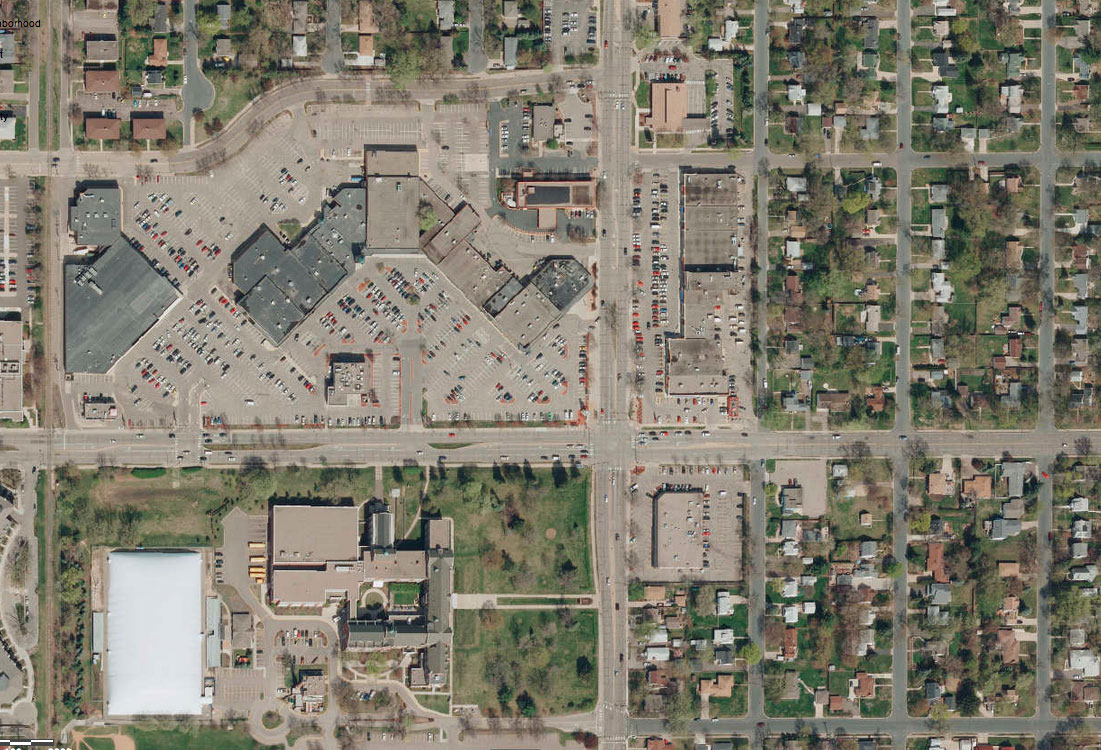
66th and Nicollet in 1956. Image from MHAPO.66th and Nicollet in 2013. Image from Hennepin County
The roadway has changed slightly, but you’ll notice the basic function of it has not changed. New turn lanes were added, and some additional trees were planted, but the basic function to move users (mostly cars) from A to B remains. Large parking lots flank all three corners (and may soon cover the fourth). Despite being a major transit node, no development at the intersection actively appeals to transit users.
Newer Attempts
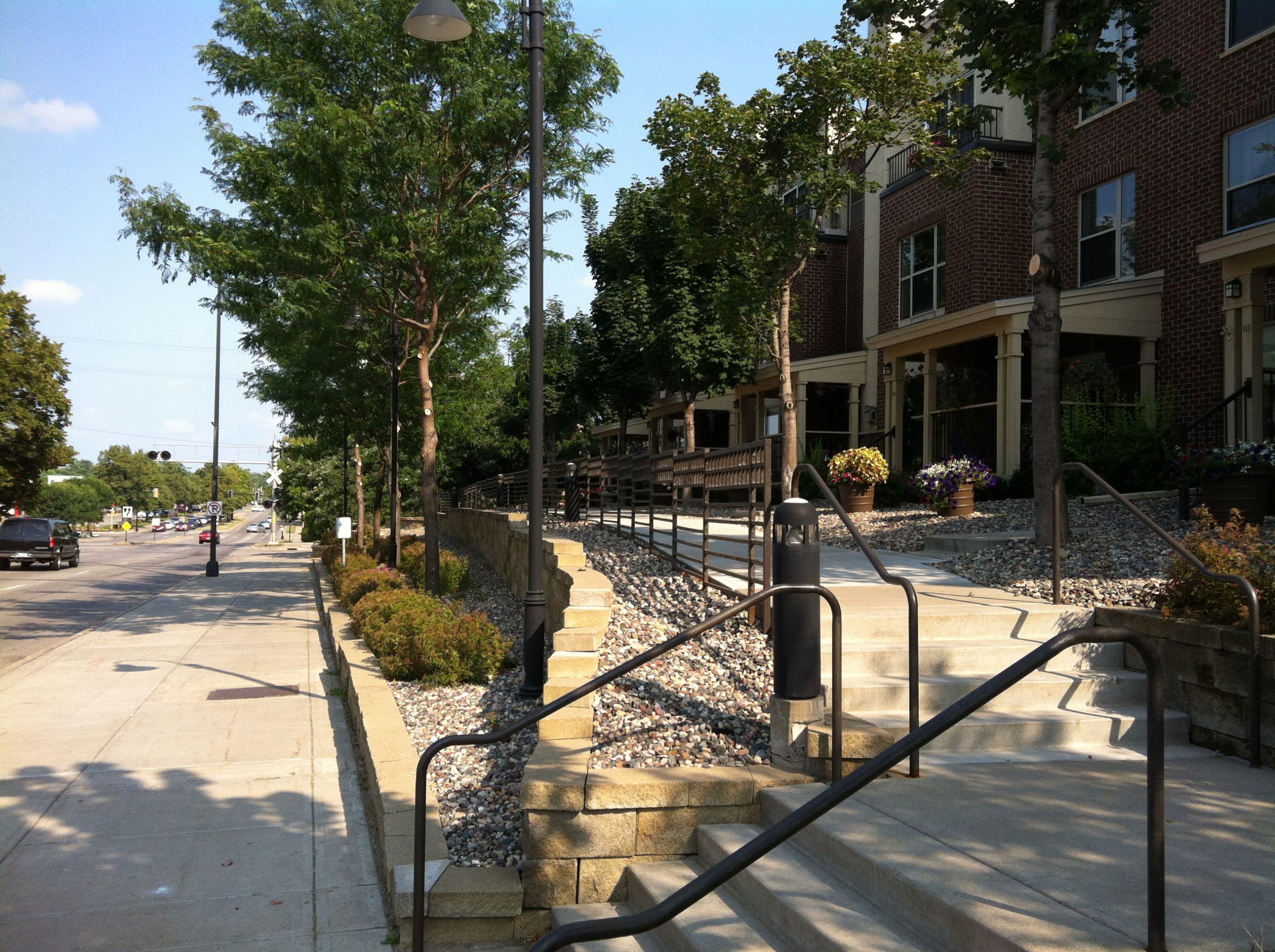
Although 66th and Nicollet remains stagnant, other portions of 66th have seen redevelopment of varying quality. One of the better redevelopments is Woodlake Center and the adjacent Oaks on Pleasant apartments, which have townhome-style frontage on 66th:
The Oaks on Pleasant apartments
It’s unclear how useful these entrances are to residents, as most appear to access the units from structured parking behind the buildings. While it’s pleasantly built, the public-facing spaces appear underutilized.
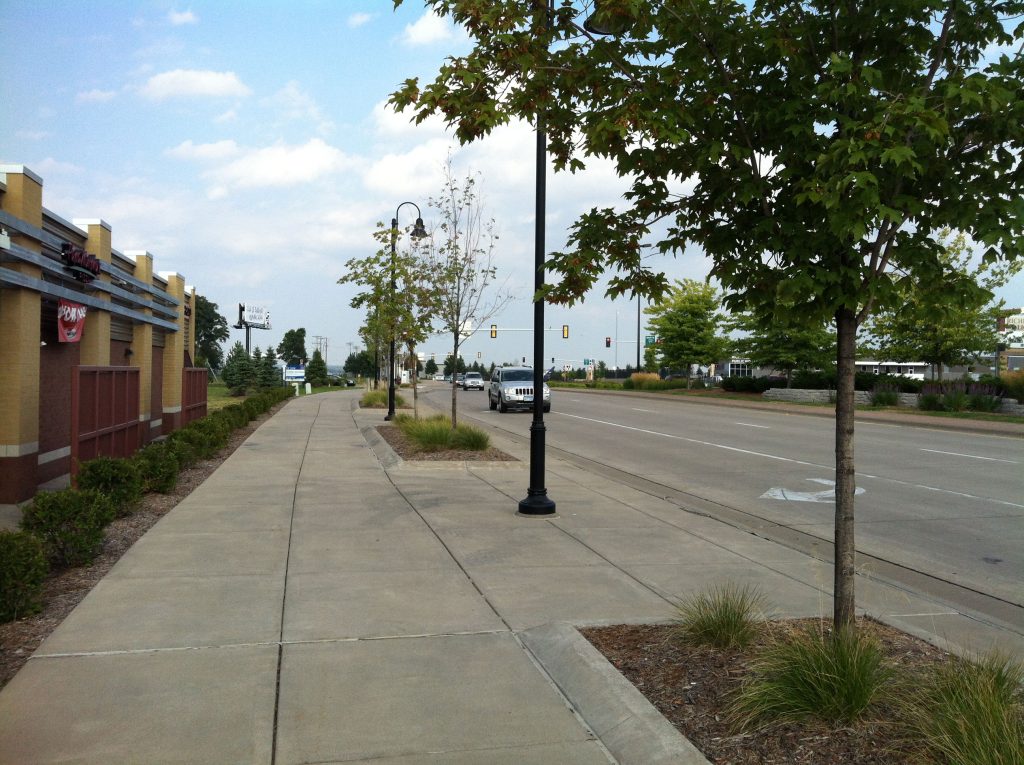
One of the largest redevelopment projects along 66th is Cedar Point Commons, home to Target and Home Depot. This complex is also one of the worst in terms of frontage. This small, far-eastern portion of 66th was reconstructed more recently, and is much more attractive than older portions. It includes boulevard trees, pedestrian-scale lighting, wider sidewalks, and landscaped medians. If you don’t think very hard about it, it’s a pleasant street.
66th Street adjacent to Cedar Point Commons
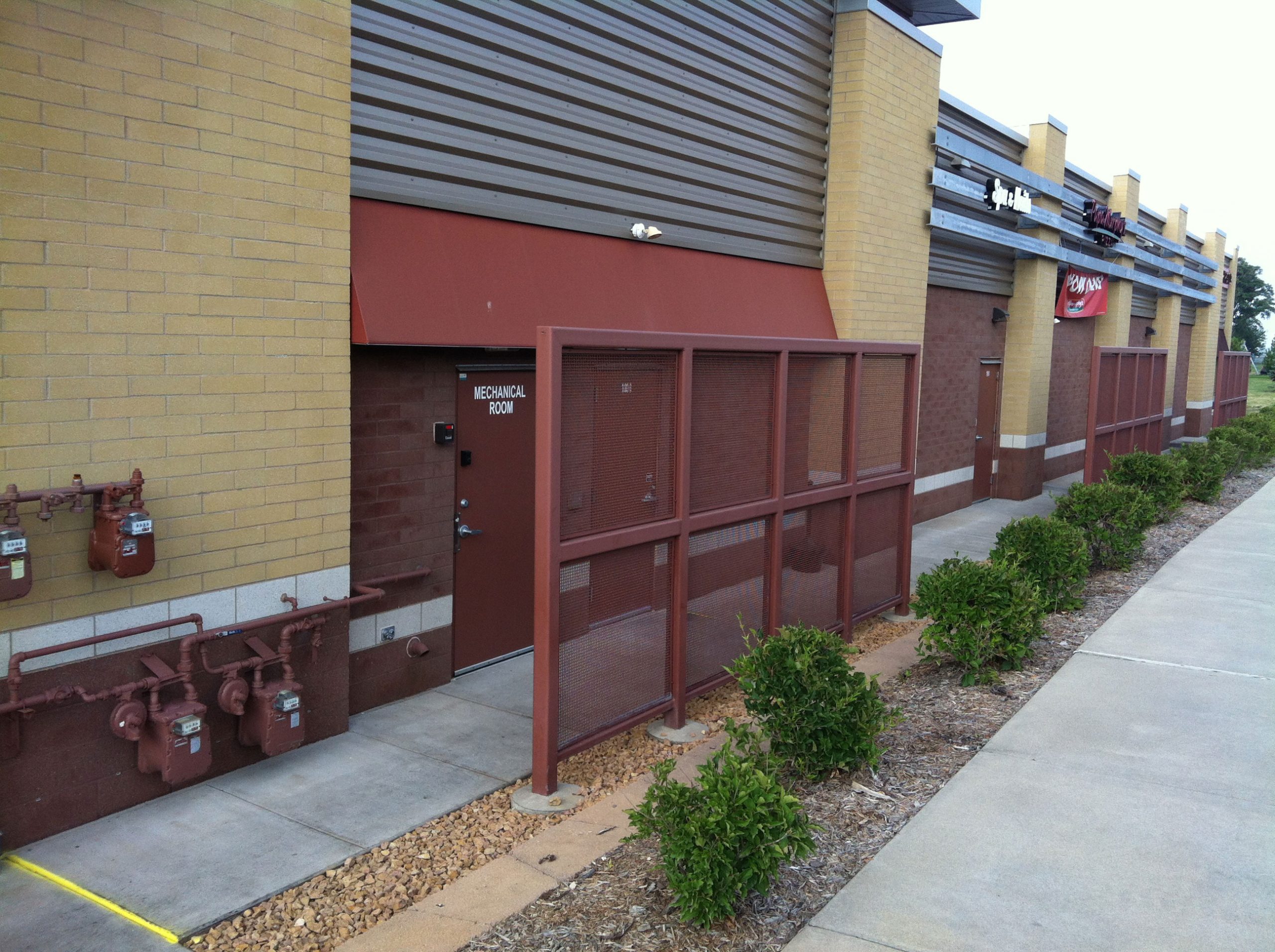
Unfortunately, if you do think hard about it — or turn your head slightly to the left — you see the problem: the frontage is made up of fire exit doors and gas meters.
66th Street’s frontage. Welcome to your friendly neighborhood Subway!
Why would a business do this — place its most unpleasant features on permanent display to the public realm? For a simple reason: from the developer’s perspective, customers come from the parking lot. When the street exists only to move people (cars) from A to B, minimal cost and effort should be expended on creating appealing frontage or entrances from that street. The developer made a rational choice, and the city planning code failed to prevent the negative consequences of that choice.
Overcoming the choice
So what is one to do, when the rational choice — to favor cars — comes at the expense of pedestrians, cyclists, and transit users? The long-term answer is to increase the popularity of other modes, by building high-quality bikeways and improving transit along the corridor. But there is an important step to help achieve that long-term goal: align the interests of motorists with those of other street users. Or, put more simply, install on-street parking.
Thus far, on-street parking has been treated like a difficult burden on the 66th Street project. Small areas are being considered for it, but engineers have focused on the ways in which it complicates accesses (driveways) and requires more land acquisition. The influence on future redevelopment has been largely ignored, at least as presented to the public.
In other projects, on-street parking is often touted for other urban benefits, including calming traffic and providing a pedestrian buffer from moving cars. But perhaps the most important benefit is that it promotes meaningful frontage. This can be clearly seen on Excelsior Boulevard in St. Louis Park, a similar county road with development of a similar age as Cedar Point Commons. For the businesses — including “small-box” chain Trader Joe’s — the most convenient location to park a car is also the best entrance for pedestrians, cyclists, and transit users.
Excelsior Boulevard in St. Louis Park: attractive and meaningful frontage, with real entrances to businesses
This serves as an immediate benefit to motorists, and it also makes walking and biking more viable, by providing more destinations that are bike/walk-friendly. In the long term, it also helps us reduce our need for low-value off-street parking.
Excelsior Boulevard has an attractive streetscape. But the decorative lighting and patterned concrete are insignificant compared to the roadway feature of on-street parking. This parking has helped to bring the most important street feature of all: meaningful frontage, and destinations that serve all users well. We must strive for the same result in planning for a new 66th Street.